Beyond Convergence: Understanding Critical Thermodynamic issues in Propylene Glycol based Brine Coolers
Introduction
Finned pack brine coolers that operate using low temperature propylene glycol solutions present significantly different thermodynamic behaviours to similar heat exchangers that run on water or ethylene glycol. These differences derive mainly from the high viscosity, prevalently laminar flow regimes, the unfavourable internal and external surface area ratio and the use of calculation correlations that can cause discontinuity in the passage between the laminar, transitory and turbulent flow regimes.
The aim of this brief guide is to provide technicians with a clear picture of the main physical and calculation issues encountered with propylene glycol brine coolers, so that they can interpret selection software results accurately and make an informed decision on which design solutions to adopt (the choice of smooth or grooved tube, fin pitch, circuitry, usage limits).
The role of viscosity and the Reynolds number
At the low temperatures typically found in brine coolers, propylene glycol presents a dynamic viscosity approximately 2 to 3 times greater than that of equivalent ethylene glycol solutions, at a given concentration (for example propylene μ in the order of 10–30 mPa·s at around -10 °C, compared to 5–15 mPa·s for ethylene). This increase in viscosity has a direct impact on the internal Reynolds number, which becomes the key parameter in understanding the flow regime and quality of thermal exchange.
The Reynolds number for internal flow is generally expressed as: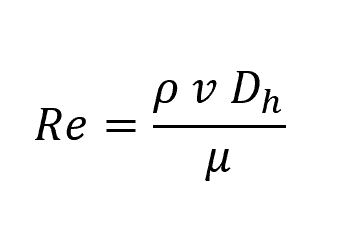 where ρ is density, v average speed, is hydraulic diameter and μ dynamic viscosity. At any given density and speed, a marked increase in μ causes a drastic reduction in Re, maintaining the flow in laminar regime or low transition even at speeds which with water or ethylene glycol, would be completely turbulent.
Under these conditions:
- classic turbulent correlations (for example Dittus-Boelter) are not applicable without appropriate adaptations and the contribution of correlations for laminar and transition regimes has a dominant effect on the calculation;
- with very small temperature differences fluid side and much longer tube lengths (batteries as long as several metres, with numerous rotations), performance can deteriorate towards very low internal exchange coefficient values, leading to flow conditions comparable to laminar even when a certain turbulence would be expected.
Controlling resistance and ratio between surface areas
The global thermal exchange coefficient U in a finned pack heat exchanger derives from the combination of the air side and fluid side resistances and the material of the walls, taking into account the internal to external surface area ratio. From a practical point of view, it is essential to identify the controlling resistance, in other words the prevalent thermal resistance which limits overall performance.
In applications using viscous propylene glycol, the combination of:
- low fluid side internal coefficient values h, due to reduced Reynold numbers;
- very high external/internal surface area ratios (eg values in the order of 28-30);
means that the controlling resistance moves from the air side to the internal side of the tubes. In such cases, a further increase in the air side finned surface does not bring any significant improvement in heat exchange capacity, as the ‘bottle neck’ lies in the internal fluid film.
Calculation correlations and capacity ‘level’
The calculation correlations of the internal exchange coefficient play a critical role in shaping the passage between the laminar, transitory and turbulent flow regimes. Methods deriving from correlations such as the Gnielinski equation usually foresee a continuous connection between the reference value of the laminar flow and that of the turbulent flow, calculating both contributions and combining them via appropriate averages or weights in the transition region.
If the management of this transition is too ‘rigid’ (for example with fixed Reynolds thresholds and sudden formula changes), the model can introduce an artificial discontinuity in the thermal yield. In practice the following may be observed:
- variations in capacity of just a few m³/h which determine yield to fall by around 7-10%, even in almost unvaried thermodynamic conditions;
- disproportionate differences between ΔT entry-exit fluid and actual capacity, attributable to the sudden passage from laminar to turbulent correlations or vice versa.
From a physical point of view, in the laboratory, the passage from laminar to turbulent is in fact gradual: the flow structure evolves and empirical models overlap, without distinct ‘steps’. In order to reflect this behaviour better, an effective approach is to introduce continuous interpolations between the value of h calculated in laminar and the value calculated in turbulent within a defined Re interval, thereby reducing the number of macroscopic numerical steps.
In applications with highly viscous propylene glycol and small ΔT values, operation of the device can take place within the transition zone itself, making the yield extremely sensitive to small variations in capacity or operational conditions.
Geometric solutions: grooved tube, fin pitch and circuiting
Increase of the internal surface: grooved tube
An important technical lever is the use of grooved tubes fluid side, rather than smooth tubes. The main benefit, in this context, is not only a potential increase in the internal heat exchange coefficient thanks to secondary flows or induced turbulence, but, above all, the increase of the internal wet surface area.
Roughly speaking:
- a grooved tube can increase the internal surface area to values of about 1.6 times those of a smooth tube and in special configurations up to 2-2.5 times as much, depending on the geometry of the grooves;
- in the calculation model, this effect is introduced via a surface factor that reduces the ratio between total external and internal surface area, bringing initially very unfavourable ratios (eg 28-30) closer to more balanced figures (eg 12-15).
By reducing the surface area ratio:
- the contribution of the internal coefficient in relation to the air side surface area increases because it is divided by a smaller denominator;
- the controlling resistance balances itself again and the system moves towards global coefficient values more in line with design expectations.
However, the adoption of a grooved tube has some design-related consequences:
- increased load losses, due to greater internal roughness;
- the need to review the circuiting (for example by adding more parallel circuits) to keep load loss within acceptable values, affecting costs, space occupied and the plant’s hydraulic complexity.
Management of surface area ratios: fin pitch and pack density
Another geometric lever is the variation of the fin pitch (finned step). By increasing the distance between fins:
- the finned surface per metre of tube is reduced and the increase in air side surface area is therefore more limited;
- the external to internal surface area ratio diminishes, reducing the penalising factor by which the internal coefficient is applied to the external surface.
In conditions characterised by minimal temperature differences and highly viscous fluids, it can be more efficient to work with a less dense finned pack which is better balanced fluid side rather than systematically pushing for the maximum finned surface area.
Circuiting and load losses
The internal circuiting must take into account two opposing requirements: ensuring sufficient Reynolds numbers to avoid excessively laminar regimes and maintaining the overall load loss within acceptable levels for the equipment. The use of grooved tubes, increasing the number of parallel circuits and the management of the internal tube route are all instruments which must be carefully coordinated in order to optimise both thermal and hydraulic exchange.
Commercial and design implications
In propylene glycol brine coolers, small variations in capacity can translate into significant variations in yield, especially when the device is operating in the transition zone between laminar and turbulent. Even moderate reductions in capacity, due for example to pump calibration, valve tolerance or dirt accumulation, can shift the calculation towards more laminar regimes, with considerably lower internal exchange coefficients.
This behaviour is also reflected in defining the range and commercial products offered:
- two configurations with very similar nominal capacity can be associated with significantly different yields and sizes, due to the numerical steps associated with the correlations;
- the adoption of models with continuous ratios reduces the risk of ‘yield steps’ that translate into ‘price steps’, which are difficult to justify to the client.
Simply oversizing the finned surface is not a universal solution; if the ratio between the surface areas remains unbalanced and the fluid side maintains very low Reynolds numbers, the controlling resistance remains internal and the increase in the air side surface area can turn out to be inefficient or even counterproductive.
Guidelines for the design of propylene glycol brine coolers
Below are some general guidelines emerging from physical considerations and calculation experience:
- Recognise the role of viscosity and flow regime
At low temperatures, propylene glycol brings, the internal Reynolds numbers, almost by definition, into a laminar zone; sizing must therefore be based on adequate correlations of these regimes, avoiding the direct transfer of approaches developed for use with water or ethylene glycol.
- Consciously plan the ratio between surface areas
It is advisable to avoid excessively high air/tube surface area ratios which shift the controlling resistance to the fuid side and drastically reduce the beneficial effect of the finned surface. The use of grooved tubes and increasing the fin pitch are effective tools to restore balance to the system.
- Manage regime transition continuously
It is preferable to use calculation engines that deal with the laminar-transition-turbolent passage using continuous ratios (average weights, interpolations on Re) and not using rigid thresholds, in order to limit yield steps exclusively attributable to numerical choices.
- Distinguish between standard ranges and specific ranges for viscous brine
It is not realistic to expect a range of standard smooth tube heat exchangers to cover all operational conditions, including the more challenging ones when propylene glycol is used. It is technically advisable to include dedicated families, with specific geometries, circuiting, tube types and calibrated correlations for this type of fluid and temperature.
- Calibrate models acccording to experimental data
In order to bridge the gap between calculation and reality, it is essential to carry out specific trials on propylene based batteries (at different concentrations, temperatures and sizes) and calibrate the correlations according to this data, while accepting as the objective limited errors in yield and load losses.
A better understanding of these aspects enables technical teams to interpret selection software results with greater awareness and communicate more effectively with constructors when it comes to geometry, surface area ratios, tube selection and range definition, thereby avoiding reliance on oversizing alone.