5G and the automotive sector: how one will change the other
5G is the new connection technology that will soon become widespread. It is already operative in major Italian cities and should be available throughout Italy within the next few years. Switching to 5G means having access to greater band width and much shorter response times.
These characteristics are, on the one hand, destined to bring increases in productivity (it is estimated that in those companies equipped with the new technology, production has risen by 20-30%) and at the same time, revolutionise many different sectors. Among these, the automotive sector could be the one to benefit the most.
Opportunities offered by 5G in the production of electric vehicles
According to analysts, one of the most tangible impacts of 5G on the automotive sector regards the speed with which new generations of cars will be brought to market. More specifically, the biggest increases will be registered by those plants specialising in the production of electric vehicles.
In fact, that sector has not yet exploited the 5G wave, but it has already been demonstrated how improved connectivity is able to generate more reliable control, analysis and operational methods within a productive process.
This theory is supported by the fact that, in recent years, the production of electric vehicles has attracted a growing number of investors. The market is booming and improved production capacity could be the factor that determines the transformation of electric vehicles from a niche market product into the new standard.
Furthermore, it should be noted that, for businesses, an increased speed in launching new products onto the market undoubtedly translates into greater returns on their investment.
Thanks to 5G self-driving cars will finally become reality
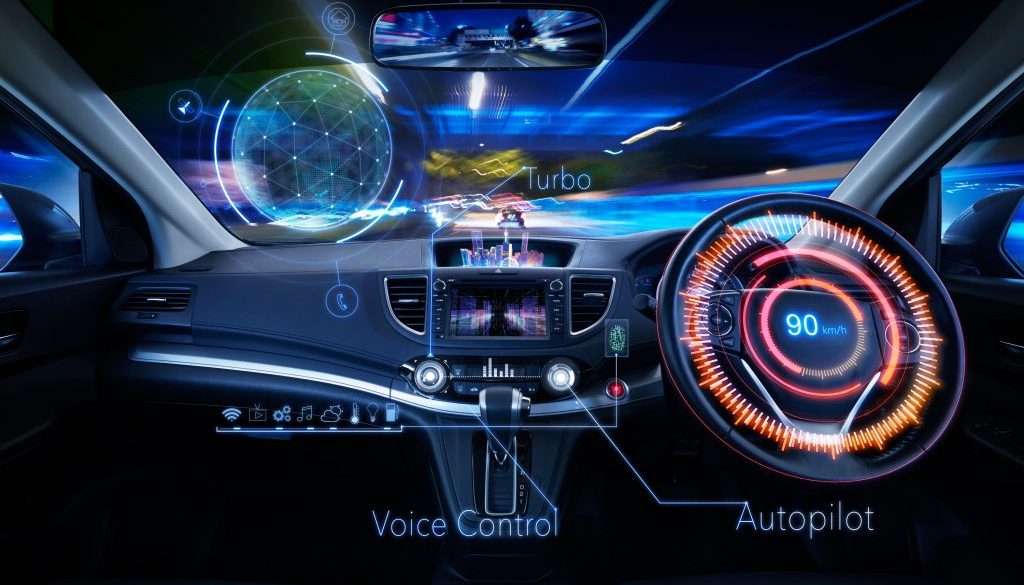
Another interesting area in which 5G will make a significant contribution to the evolution of the automotive sector involves self-driving cars. In order for this revolutionary technology to be efficient enough to be implemented in mass market vehicles, it needs a data gathering capacity which is both highly efficient and fast.
Cars fitted with this driving system operate via a constant dialogue with purpose-built databases. They store data which is crucial for the artificial intelligence which controls the vehicle and is used to construct the driving responses according to the route and potential obstacles.
On this basis, it is clear that 5G is set to revolutionise the automotive sector. The reduced response times from and to the servers and the extended band width which is able to transmit enormous quantities of data, will open the gates to increasingly accurate and high-performing self-driving vehicles.
Thanks to technological advances resulting from the implementation of 5G, it is expected that new services related to the automotive sector will also become available. A good example could be shared services designed to improve the experience of self-driving vehicle users.
5G will not only benefit the automotive sector
5G connectivity is an extremely versatile technology which will bring numerous benefits to different sectors. As well as the automotive industry, it will bring great improvements in efficiency in the healthcare, communications and transport industries, as well as industry 4.0 production.
Smart living is another area in which 5G is already starting to set new standards, with IoT devices becoming ever more sophisticated and responsive. So, all in all, in contrast with its predecessors 3G and 4G, 5G is surely destined to play a major role in years to come.
Translated by Joanne Beckwith