UNILAB PRESENTS! FFE & TSR
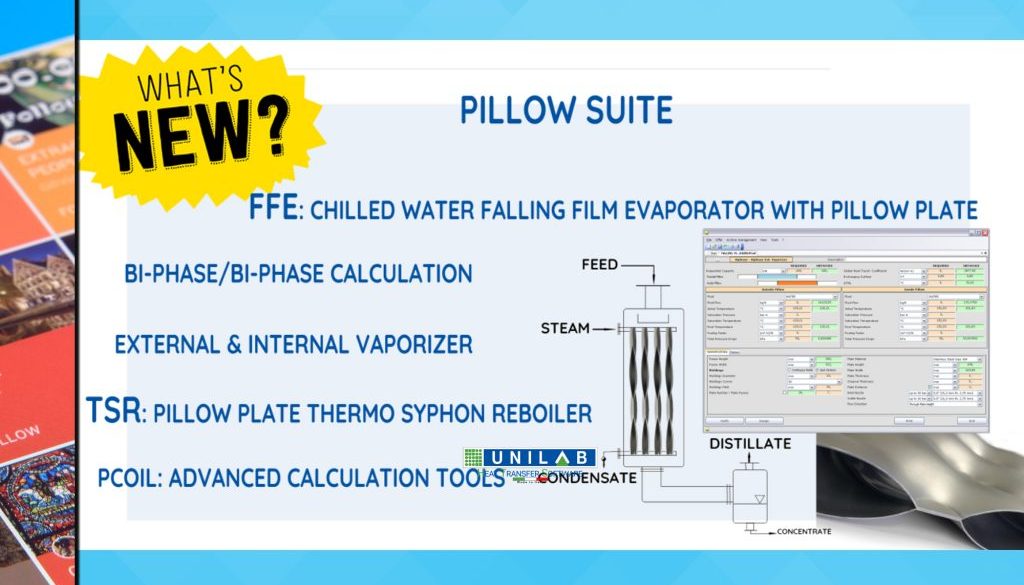
UNILAB PPFFE & PPTSR: the all new exclusive Pillow Suite modules for the Calculation & Design of Pillow Plates Falling Film Evaporators and Pillow Plates Thermosiphon Reboilers, the result of multiple years of experience & know-how in Pillow Plates heat exchangers!
Pillow-Plate technology-based heat exchangers are an interesting alternative to a large number of conventional heat exchangers in the process industry thanks to the favourable combination of thermo-fluid-dynamic efficiency and construction-related properties that make them advantageous to use.
PPHE actually offer several potential advantages over traditional heat exchangers, such as intensified heat transfer, extremely flexible design, compact, light and pressure resistant construction, low pressure loss, as well as low construction and operating costs. All these reasons justify the growing success of PPHE technology in the process industry.
Two examples of applications in which the unique characteristics of PPHE heat exchangers can be advantageously exploited are falling film evaporators and thermosiphon reboilers.
In falling film evaporators, a thin liquid film flows down, driven by gravity, usually at the outside of vertical pillow plates. While flowing down the plates, the liquid is partially evaporated with liquid and vapor in concurrent flow to the lower exit of the exchanger: separated flow paths for liquid and vapour along the evaporator heat transfer surface assure low pressure loss, allowing for treatment of thermally sensitive products, as in the food industry, in the concentration of milk and fruit juices.
Falling film heat exchangers are preferred to traditional heat exchangers due to their low liquid holdup: minimum residence time in combination with good heat transfer performance result in extremely low thermal stress exerted to the treated product.
This allows to low driving temperature differences between heating and evaporation sides.
The extreme flexibility of PPFFE is favouring its diffusion in many sectors, from its use as elements in distillation towers to its use as chillers heat exchange component in the HVAC sector.
Thermosiphons are the most widespread solution for the production of reboilers for industrial use. They offer high heat performance at minimum investment and operating costs.
Thermosiphon reboilers build on density difference of the single-phase liquid feed and the two phase vapor/liquid mixture in the reboiler. As a consequence, thanks to the absence of pumps and circulators in their operational design, shear stress to the product is kept at a minimum and so are maintenance costs.
Pillow plates thermosyphon reboilers represent a very innovative type of reboiler.
For PPHE reboilers evaporation usually takes place between the plates, while service medium flows within the plates. However, the flexibility of PPHEs means that reboiler heat exchangers can be realized where the two fluids flow in an inverted configuration compared to the previous one.
High temperature water vapour (e.g. above 130°C) is frequently used as a condensing medium. The reboiler is then used to evaporate water, which flows through the passages between the plates, thus producing low-pressure steam flows (e.g. two Bars). Often a two-phase mixture is produced at the reboiler outlet and conveyed to an external flash drum to separate the dry saturated steam, but the flexibility of the heat exchangers based on Pillow-Plate technology lends itself to reboiler applications for the production of superheated steam.
As mentioned above, most frequently saturated water steam is used as a service medium: in addition to this, possible vectors as organic vapours, thermal oil or pressurized liquid water may also be used.