The main technologies supporting the HVAC industry
There are many technologies supporting the HVAC industry and all of them contribute to making the air-conditioning sector more efficient and less wasteful. The use of new construction methods, the provision of increasingly customised services and a focus on energy consumption have enabled considerable savings and the continuing growth of that sector.
What has made this progress possible is the implementation of cutting-edge technologies during every phase of development: from design and construction to distribution. The finished product is the result of combining these new approaches, which add great potential and make all the difference.
Virtual reality: a new way of understanding HVAC systems
One of the most recently introduced technologies supporting the HVAC industry is virtual reality. It allows companies to show clients the capabilities of their air-conditioning systems (even before they have been assembled), offering a range of solutions to fit the building where they are to be installed.
Thanks to purpose-built simulation programs, virtual reality is also an excellent training tool, which can teach new technicians how to carry out specific operations. This allows them to learn the correct procedures in order to identify and fix a system failure in a less stressful and more convenient setting.
Load calculation app
In HVAC systems, the workload is the parameter that indicates how much energy is needed by the system to heat or cool a particular space. This calculation allows the amount of electrical power required to bring a room or building to the correct temperature to be calculated, so that the most suitable power supply system can be selected.
In the past, this calculation was carried out manually by engineers, with inevitable errors and approximations, which led to considerable energy wastage. Now however, that job can be delegated to simple apps which can be downloaded onto a smartphone or tablet.
By entering the surface area of the building, the number of rooms and the estimated number of people who use that building, it is possible to calculate the required data in loco, so as to give the purchaser a better idea of how much they will need to spend. Some software is even able to calculate the diameter of the pipes required to maximise performance.
Focus on health and safety
In addition to pure energy efficiency, clients ask the HVAC industry to guarantee the quality of air present inside buildings. In particular, a lot of attention is being paid to the reduction of allergens and the elimination of fine dust particles. The most modern systems include mounted filters specifically designed to capture these harmful substances, thereby ensuring the highest possible level of purification.
In this case, the real technological innovation can be attributed to the methods used for monitoring the air. Highly sophisticated, sensitive sensors, fitted directly onto the air-conditioning units, are able to analyse the air quality in real time, and notify the user if and when the filters need changing.
Smart and digital thermostats
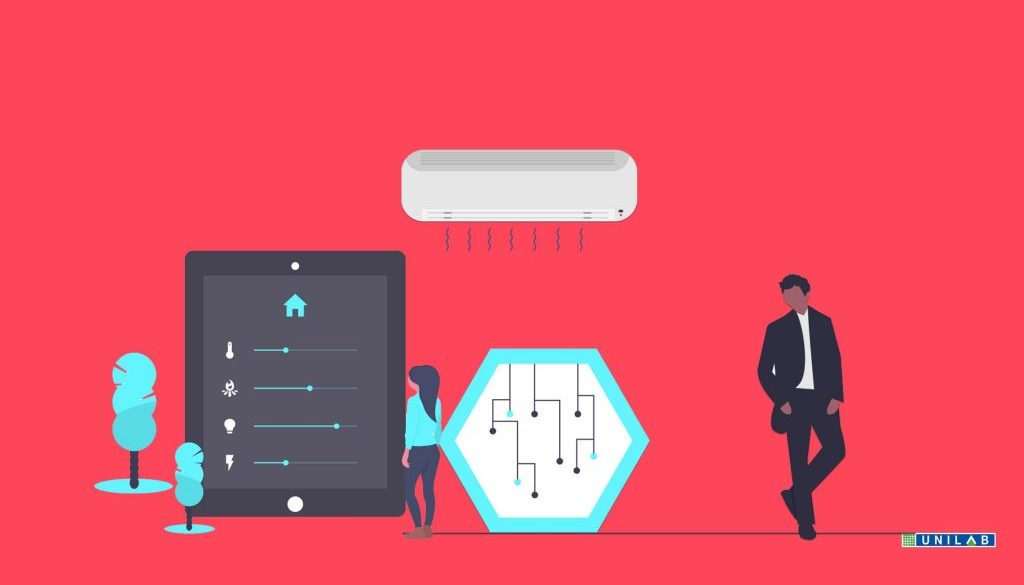
An important technology which supports the HVAC industry is also present in thermostats: digital models enable the user easy access to all the configuration options of their air-conditioning system, while, at the same time, providing useful data to help set the temperature as efficiently as possible.
From the smart point of view however, the option of managing the microclimate in the home remotely, either by smartphone or tablet, has enormous potential. For example, by being able to turn your home heating system on from the office at the desired time, you can make significant savings.
Furthermore, intelligent HVAC systems are able to recognise any malfunctions autonomously and contact specialised technicians directly. The internet of things (IoT) is a form of technology destined to expand its presence in this sector, bringing some significant advantages.
Translated by Joanne Beckwith