Heat Pipes – Part I: from aerospace to air conditioning applications
The heat pipe is a device of very high thermal conductance. The initial formulation of the heat pipe concept can be traced to the patents of A.M. Perkins and J. Perkins in the mid-1800s. These patents focused on a device referred to as the Perkins tube, which utilized either single- and two-phase heat processes to transfer heat from a furnace to a boiler. An example of the Perkins tube is proposed in Figure 1 (left-side). On the right side, Figure 1 also reported the device patented by F.W. Gay (1929), in which a number of vertical tubes were arranged with the evaporator located below the condenser.

Figure 1: Perkins tube (left-side) and thermosyphon heat exchanger patented by F.W. Gay (right-side).
These devices, which are classified as thermosyphon, laid the groundwork for the later development of what is now commonly referred to as the heat pipe.

Figure 2: Thermosyphon vs Heat pipe design.
To understand how a heat pipe works, it is worthy to describe the operation of a thermosyphon; looking at Figure 2, in this device, a small amount of water is placed in a tube from which the air is then evacuated and the tube sealed. The lower end of the tube is heated causing the liquid to vaporize and the vapour to move to the cold end of the tube where it is condensed. The condensate is returned to the hot end by gravity. The obvious limitation of the thermosyphon devices is that, in order for the condensate to be returned to the evaporator region by gravitational force, the latter must be situated at the lowest point, otherwise the system cannot operate.
According to Figure 2 (right-side), the thermosyphon’s concept was overcome by the heat pipe one in which a capillary structure (wicking structure) is used to promote flow of the liquid from the condenser to the evaporator, instead of relying solely on the local gravitational acceleration for the return of liquid from the condenser to the evaporator. In such device, the evaporator position is not restricted and it may be used in any orientation. The concept of utilizing a wicking structure as part of a passive two-phase heat transfer device capable of transferring large quantities of heat with a minimal temperature drop was first introduced by Gaugler (1944). In a later publication, Groover et al. (1964) presented the results of their researches and first applied the term Heat Pipe to describe: “synergetic engineering structure which is equivalent to a material having a thermal conductivity greatly exceeding that of any known metal”. Since that time, heat pipes have been employed in numerous applications ranging from temperature control of the permafrost layer under the Alaska pipeline to the thermal control of optical surfaces in spacecraft, from the energy recovery to the thermal management of electronic devices, from the thermal control of nuclear reactor core to the air conditioning and heat recovery.
Because the basis for operation of a heat pipe is the evaporation and condensation of the working fluid, selection of a suitable fluid is an important factor in the design and manufacture of heat pipes. Care must be taken to ensure that the operating temperature range is adequate for the application. While most applications involving the use of heat pipes in the thermal control of electronic devices and other systems, require the use of a working fluids with boiling temperatures between 250 K and 375 K, both cryogenic heat pipes (operating in the 5 K to 100 K temperature range) and the liquid metal heat pipes (operating in the 750 K to 5000 K temperature range) have been developed and used.
Leaving a comprehensive description of the fundamental operating principles of heat pipes and their limitations in transport properties to a dedicated newsletter, it is interesting to point out the most interesting advantages of these passive heat transfer devices.
First, because heat pipes operate in a closed two-phase cycle, the heat transfer capacity may be several orders of magnitude greater than even best solid conductors. Second, increases in the heat flux in the evaporator may result in an increase in the rate at which the working fluid is vaporised, without significant increase in the operating temperature. Thus, the heat pipe can function as a nearly isothermal device, adjusting the evaporation rate to accommodate a wide range of power inputs while maintaining a relatively constant heat source temperature. Third, the evaporator and condenser portions of a heat pipe function independently, needing only common liquid and vapour streams; for this reason, the area over which the heat is introduced can differ in size and shape from the area over which it is rejected. Finally, last but not least, the thermal response time is considerably less than for other heat transfer devices, particularly solid conductors, and is not a function of length.
In conclusion, the high heat transfer characteristics, the ability to maintain constant evaporator temperatures under different heat flux levels, and the diversity and viability of evaporator and condenser sizes make heat pipes effective devices for use in many diverse situations.
One of the best know application of the heat pipe/thermosyphon concept is on Alaska pipeline, where heat pipes are used to maintain the permafrost in a stable condition around the pipeline vertical support members.

Figure 3: Different heat pipe applications: electronic cooling (left-side), heat pipe heated bridge in Virginia, USA (right-side).
Nowadays, a very common application of heat pipes is in the thermal control of electronic devices and components, as shown in Figure 3 (left-side). An unexpected real application of heat pipes is that reported in Figure 3 (right-side); in this case, a hybrid system involving a boiler unit heating a circulating ethylene glycol system, feeding heat to the evaporators of a heat pipe assembly that then warmed the road crossing the bridge for de-icing and snow melting. The passive system installed in the bridge consisted of 241 gravity-assisted heat pipes of length 12 m and internal diameter 13 mm; different working fluids were investigated: R123, R134a, ethanol, and ammonia.
Three other examples are illustrated in Figure 4, starting from the left-side, the drawing shows the first use of heat pipes for satellite thermal control on GEOS-B, lunched from Vandenburg Air Force Base in 1968. The purpose of the two aluminum (120-mesh aluminum wick) heat pipes was to minimize the temperature difference between the various transponders in the satellite.

Figure 4: Heat pipe used in GEOS-B satellite (left-side), heat pipe heat exchanger (middle), a heat pipe solar receiver (right-side).
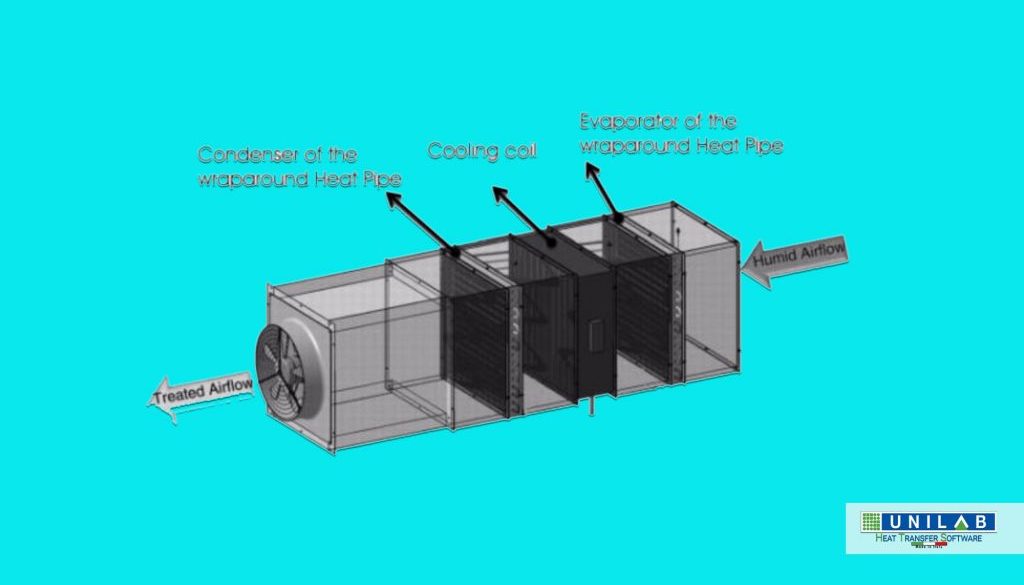
The second picture of Figure 4 (middle) shows an example of heat pipe heat exchanger, which can be used in airconditioning and refrigeration systems. The tube bundle may be horizontal or vertical with the evaporator sections below the condenser. The application of these devices is mainly focused on various kinds of heat recovery in different fields, including air conditioning and industrial processes. Finally, the last picture of Figure 4 (right-side) reports a heat pipe solar receiver, which is object of large attention for its possible future implementation in solar systems. Recently, the heat pipes have been proposed in a wraparound configuration and used in air conditioning system. This kind of heat pipes is designed, predictably, to wraparound a conventional cooling coil. As shown in Figure 5, when wrapped around the cooling coil and inserted in an air conditioning system, the heat pipe transfers heat from the warm outside air upstream of the cooling coil to the cold, dehumidified air downstream of the cooling coil.

Figure 5: Example of the application of a wraparound heat pipe to an air conditioning system.
From this brief overview, we can state that the applications of the heat pipes cover many different fields of the human knowledge, sometimes unexpected but always very useful. Their favourable features make them a reliable way to face with even more hard challenges of the air conditioning and refrigeration systems.
References
- G.P. Paterson, An introduction to heat pipes. Modeling, Testing, and Applications, Ed. John Wiley and Sons, 1994, New York, USA.
- D. Reay, P. Kew, Heat Pipes – Theory, Design and Applications, 5th ed., Ed. Elsevier, 2006, Burlington, MA , USA
Correlated Topics
- Heat Pipes – Part II Operating principles: capillary pumping pressure
- Heat Pipes – Part III Operating principles: heat transfer limits
- Wraparound Heat Pipes for air conditioning applications