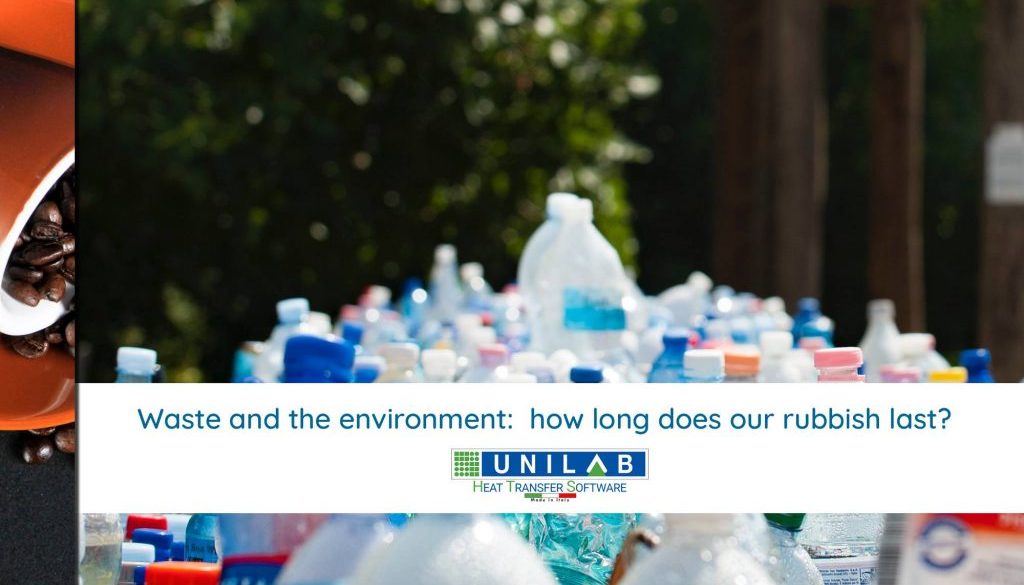
Waste and the environment: how long does our rubbish last?
How long does waste last in the environment? In order to answer this question, we must first discuss biodegradability: a typical characteristic of organic substances, which enables the correct ecological balance to be maintained on Earth.
In reality, biodegradability comes about at the moment when a decomposable substance is attacked by saprophytes. These are special bacteria able to extract the enzymes which make that particular substance decomposable.
While decomposable refuse is absorbed into the ground, waste which is not decomposable remains on the surface, causing phenomena such as pollution and other serious issues affecting the environment. Unfortunately for us, nowadays most commonly used objects are not completely decomposable.
To better appreciate this point, it is sufficient to realise that natural composts such as paper are decomposable, while the many synthetic products in circulation are not, because there is no naturally-occurring bacteria capable of breaking down the materials they contain.
It may be helpful to understand that, for example, it takes the environment 50 years to absorb a metal tin, 4000 years for a glass bottle, 450 years for a disposable nappy, between 20 and 100 years for an aluminium tin and between 100 and 1000 years for plastic cups and plates.
So let’s take a closer look: while waste such as apple cores takes on average two weeks to decompose, paper napkins, newspapers and paper bags take an average of one month. Banana skins and cereal packets take about six weeks, while two to three months are required for milk cartons.
While t-shirt cotton and pocket books take six months, woollen clothes take about one year. Orange peel requires about two years, while woollen coats take up to five years and plastic bags between 10 and 20 years (or maybe a lot more).
Glass jars may require a period of between one and two million years, while batteries containing chemical substances such as mercury and lead take even longer (so it is strictly forbidden to throw them on the ground or in non-specific waste bins).
From this perspective the situation seems dramatic and in fact we must admit that this is the case. Beaches, seas and lands which are filled with refuse material are to be found all over the planet and, as things currently stand, a solution would seem hard to find.
On the one hand there are governments and governments which are incapable of adopting effective measures, while on the other there are people who are not very aware of these issues and still not well-informed as to how to manage the situation correctly.
Never before have the actions of an individual been able to guarantee such enormous improvements in the short, medium and long term. These improvements are attainable by simply separating your waste each day and making an effort not to add to global pollution.
From this point of view, it seems simple, but in reality it isn’t at all. While making an occasional mistake is admissible, in some cases it becomes a question of laziness. It is the same laziness which deters people from bothering to walk a few extra metres to reach a waste bin.
Refuse and decomposition are different parts of the same big problem, which has always affected our planet. It is a planet forced to submit to the presence and actions of human beings which, as the years go by, could really overturn its delicate ecological balances.
Translated by Joanne Beckwith