AI and air-conditioning of data centres
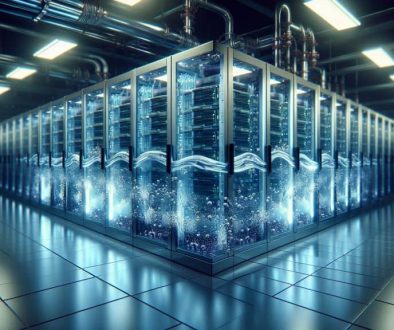
The range of applications of artificial intelligence is getting wider all the time and now includes the air-conditioning of data centres which supply servers, allowing us to carry out searches, watch videos and send emails.
Their efficiency is fundamental and also depends on temperature control and optimisation. Among the objectives of those working in this field, we may include the fight against climate change and the reduction of carbon dioxide emissions at a global level.
It has become possible to reach such important results thanks to the use of artificial intelligence, in processes which are still supervised by human experts and constantly monitored.
Data centre cooling: how it works
The latest developments regarding the use of AI for the air-conditioning of data centres involve the analysis by artificial intelligence of huge amounts of data received from numerous sensors (of temperature, power consumption etc.) approximately every 5 minutes.
The data in question is used to power deep neural networks, thanks to which it is possible to predict the environmental impact of the temperature of the data centre itself.
By using artificial intelligence, it is subsequently possible to identify the best steps to take in order to reduce energy consumption, without compromising security requirements.
The indications regarding these actions are sent to the data centre, where they are subjected to verification by the control system and then implemented. This system was developed as a response to feedback from various data centre personnel who noticed that during data centre use, excessive levels of effort and supervision were required.
Energy savings and lower running costs
Behind this system of data centre air-conditioning, lies the aim of obtaining energy savings while achieving lower running costs. In order to appreciate the dimensions of this, it should be noted that in just 5 minutes, AI is able to analyse billions of units of data, as it searches for the most useful data to obtain the desired results.
During this process, all actions which could constitute a risk to the security of the data centre itself are discarded.
As mentioned above, all this still requires the intervention of human professionals. It is important to consider that, in order to avoid errors, AI must follow instructions and restrictions which only human operational ability is able to provide.
The instructions are sent via cloud to a physical data centre, enabling the control system to verify them according to the parameters mentioned above. The operators still maintain control of the situation and are able to exit the AI controlled mode at any time.
Based on this scenario, the control system is able to transfer, without a continuity solution, numerous heuristic rules which are fundamental to automation in today’s world.
What are the advantages during winter months?
The application of AI to the air-conditioning process of data centres turns out to be very advantageous during winter months. During that period of the year in fact, thanks to artificial intelligence, data centres are able to produce water which is colder than normal.
The result is an increase in performance which can exceed 18% in a year. This technology may also find applications in other industrial sectors, thereby helping to optimise global electricity consumption.
All that remains is to await the next developments in an approach first used in 2016, with the introduction of AI systems used to send suggestions to data centre operators.
Translated by Joanne Beckwith