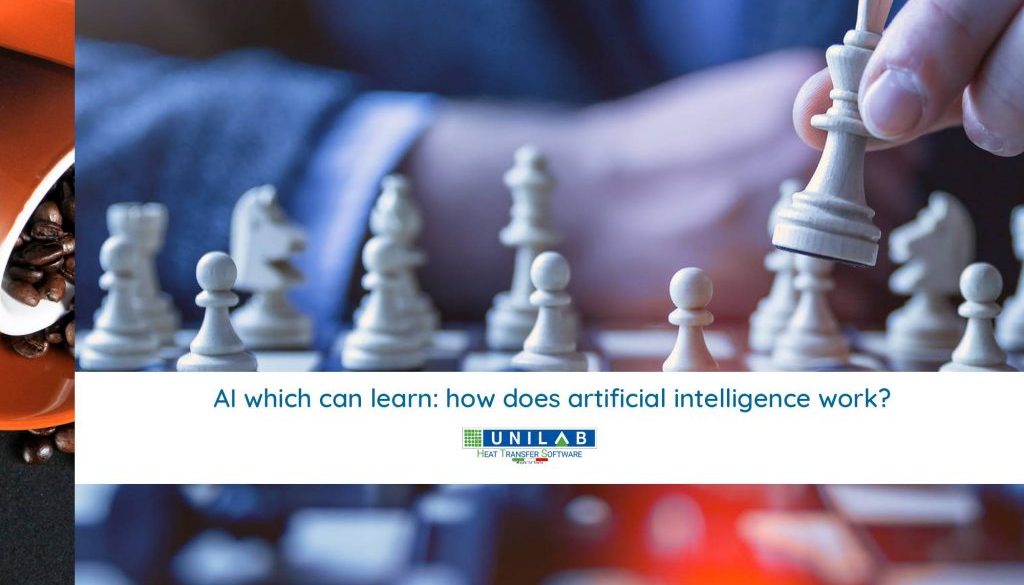
AI which can learn: how does artificial intelligence work?
Nowadays it is almost impossible not to have heard of artificial intelligence. As shown in the case of Alpha Go Zero developed by Google, IAs are now able to play board games without the help of human beings.
In order to understand how they work, it is helpful to consider abilities used by animals (and human beings) such as movement through space. Such an apparently natural act as this, in reality, relies on a very complex mechanism. The details were discovered in 2005, when a team of scientists (awarded the Nobel prize) identified the role of the so-called grey cells: neurones which form a hexagonal pattern, fundamental for spatial movement.
These cells, also support movement controlled by vectors, allowing the subject to move through space and work out the distance between him and a certain destination point and which direction to take in order to reach that point.
Grey cells and computational applications
For over 10 years, the computational applications of this discovery have remained shrouded in mystery. Things changed however when it was discovered that something similar to these grey hexagonal forms were emerging inside virtual networks. The algorithms of the human brain may then constitute an excellent source of inspiration for the architecture of automated learning.
Artificial intelligence: the latest news
Following our brief introduction to the basis of artificial intelligences, we will take a look at the latest developments. We have already mentioned Alpha Go Zero, Google’s artificial intelligence, which learnt to play Go (a Chinese game which goes back thousands of years), without the need for human intervention. The old version of the AI managed to beat the human Go champion several times in early 2017.
The new version is even better. The scientists from the Big G team taught it the rules of the game. From then on it continued to play completely self-taught. After only 3 days, Alpha Go Zero was already capable of beating its previous version, Alpha Go.
Behind the development of the AI in Alpha Go and Alpha Go Zero, is the team of researchers known as Deep Mind: a start-up acquired by Google in 2014. It is they who carried out the research which has led to the application of grey cell patterns to automated learning.
There is no denying it, the frontiers of artificial intelligence are extremely interesting and the example of Deep Mind and Google reflect this. In fact, the Deep Mind team is developing models of artificial intelligence with the purpose of emulating human imagination. The objective is to obtain an AI able to foresee the consequences of a specific action. The first step on this route was the project Alpha Go and Alpha Go Zero.
In the thousand-year-old Chinese game, AI is in some ways obliged to leave space for intuition. The game in question actually has too great a number of moves to obtain an efficient computational processing and to keep control of all possible resulting scenarios.
In order to obtain the best results, researchers have used a combination of approaches, including, interestingly, the system of learning by trial and error, as well as deep learning. This latter method, just as in the human brain, is based on the analysis of a large quantity of data.
Translated by Joanne Beckwith