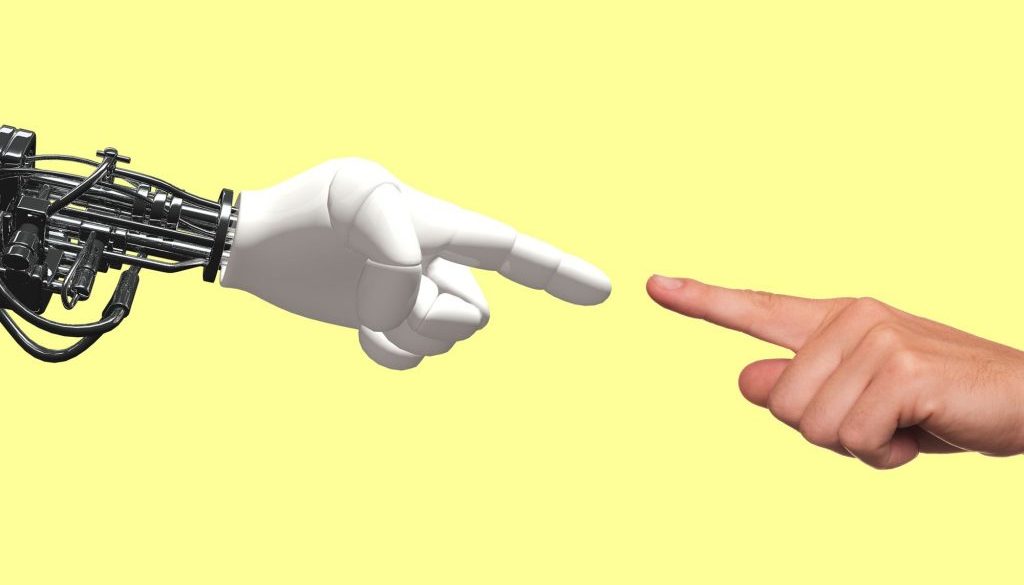
Augmented humanity: a support for humanity or a replacement?
The phrase augmented humanity refers to the concept that one day, technology will become so omnipresent in the lives of human beings that it will be practically indispensable. Although this sounds like the beginning of a classic science fiction film, it is undeniably the precise direction the world is heading in.
It is sufficient to consider how much each individual’s daily life has changed in the last twenty years. Smartphones, smartwatches, smart TVs and other devices designed to interact directly with human beings are now present in every environment, both professional and none.
The theory of Ubiquitous computing
The evolution towards augmented humanity was first theorised in 1991 and was given the name Ubiquitous Computing (subsequently abbreviated to Ubicomp). It can be divided into three main phases, which underline the change in the relationship between man and machine:
- The first phase is the Mainframe, in other words many people and a single computer;
- The second phases foresaw the rise of the personal computer, based on the paradigm of one person per computer;
- The third phase (the current time and the near-future) regards smart devices and is based around the concept of many computers for one single user.
In this last phase, there is specific reference to the ubiquity of computers (and other devices connected to them) as a way for human beings to remain constantly connected. Passing from one device to another takes place in a totally natural way.
By observing the daily habits of people in this precise historical period, we cannot fail to find confirmation of the above-mentioned theory. It is sufficient to think how we can transfer from a smartphone to a pc screen simply by looking up (we even use wearable technology to check the time, such as smartwatches or other devices).
How the world of work will change with augmented humanity
The current technological evolution does not only involve free time and daily life but, in fact, its dominance is even more tangible in the world of work. The birth of AI, the development of ever-more autonomous machines and the gradual decrease in the need for staff to carry out daily tasks, are all alarm bells which should not be ignored.
The concern shared by many workers over the risk that they may one day be replaced by machines is understandable, but augmented humanity seems to have already take this possibility into account.
According to some predictions, it will not only be technologies that evolve, but also human beings. By delegating repetitive, mechanical tasks to robots, man will acquire a different role, with greater responsibilities. New professions will emerge and there will be a standardisation of human skills.
Workers of the future will not be limited by their level of education, their gender or geographical origin: there will simply be employable and un-employable people. The real differences between them will be determined by abilities and passions.
The role of the human employee will revolve more around mindfulness than physical work, while ideas and creativity will be given pride of place above all else. This aspect will in part be linked to what is known as the Ever Changing Business Model.
This is a new production method, in which the lifecycle of products will be drastically cut short and often cut off before it has reached its full potential. This will be a result of the continual request for innovation on the part of the public (something which we are already seeing, if we take for example the speed with which new models of smartphone are produced).
Translated by Joanne Beckwith