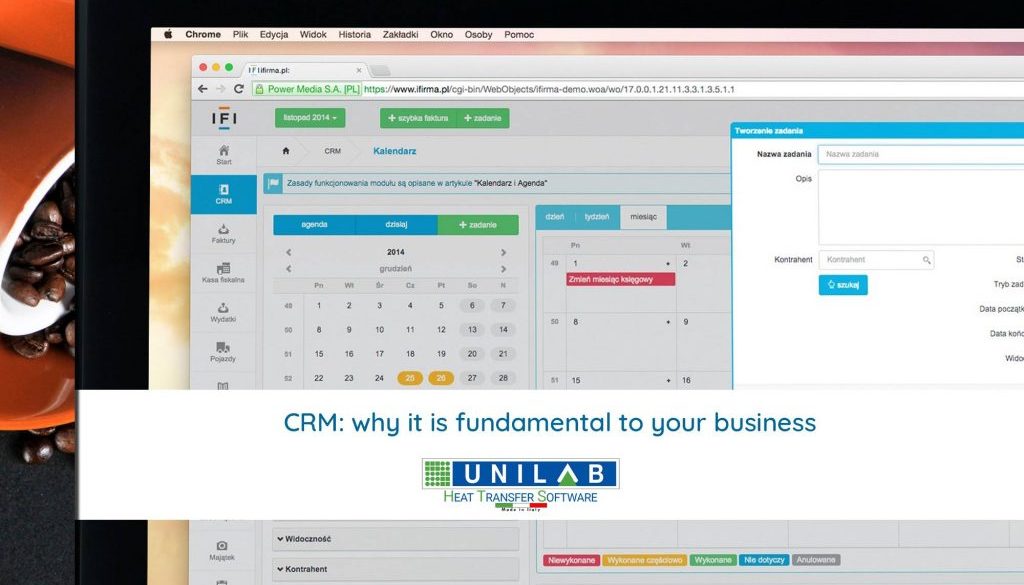
CRM: why it is fundamental to your business
Introducing CRM (Customer Relationship Management) into your company could bring considerable advantages, because as well as enabling staff to be more efficient, better-informed and quicker during project development, it allows them to understand customer needs better and to automate many routine tasks.
Regarding this last point, suffice it to say that sales staff who are not equipped with CRM waste between 20 and 25 percent of their time on filling in forms, revising reports, entering data and various other activities which could easily be managed by a software program. Such tasks are superfluous for those whose priorities lie in other more important areas, such as relationship building.
The first big improvement this instrument can guarantee involves the marketing department, which, thanks to CRM, will be able to categorise the client base according to their purchasing habits or requests and create ad hoc marketing campaigns, designed to win over a large number of new clients to your product.
In addition, Customer Relationship Management also has the capacity to improve customer care by building customer loyalty. This stems from the fact that, as soon as someone requests support, the staff member providing it seems more efficient and organised, because they have all the data relating to that client at their fingertips.
Furthermore, a CRM also helps managers to take more effective decisions: considering that all information regarding clients, sales, contacts, operational activities etc. is logged by the software, it becomes a kind of truth benchmark which enables the analysis of the Key Performance Indicator in order to improve company performance.
Following this brief summary of the advantages of this software, let us now explore how to choose the most suitable version for your company. The first consideration is the price, which can usually be split into variable monthly instalments according to how many people use it, functions required, number of contacts etc.
In order to select which CRM to adopt, it is essential to consider its ease of use (because an over-complicated program risks causing more problems than it solves). It is also important to consider the customization options (so as to understand whether all the required operations can actually be carried out).
Another important aspect is compatibility with external software used by the company (good CRM software can be integrated with many programs but is essential to check that those in use are compatible). If you operate in a specific sector, it is also important that the chosen software should be specialised in that niche area (finance, catering etc.).
That’s not all though. In order for the CRM to be perfect it must be equipped with Cloud technology (in order to access the required information any time anywhere), it must allow access via mobile devices (possibly via an app) and it must guarantee security (as it will contain the most sensitive company data).
By making a careful and logical choice, you can save time and money, improve e-marketing, take advantage of some extremely useful functions and provide support to the sales team, while at the same time simplifying the various executive processes and bringing real benefits to all company departments.
That concludes our brief introduction to Customer Relationship Management: an instrument designed to facilitate business development by automating routine operations, speeding up processes and guaranteeing a better service for clients. In other words, software that all growing businesses should have access to.
Translated by Joanne Beckwith