Data Centre: what it is and how it works
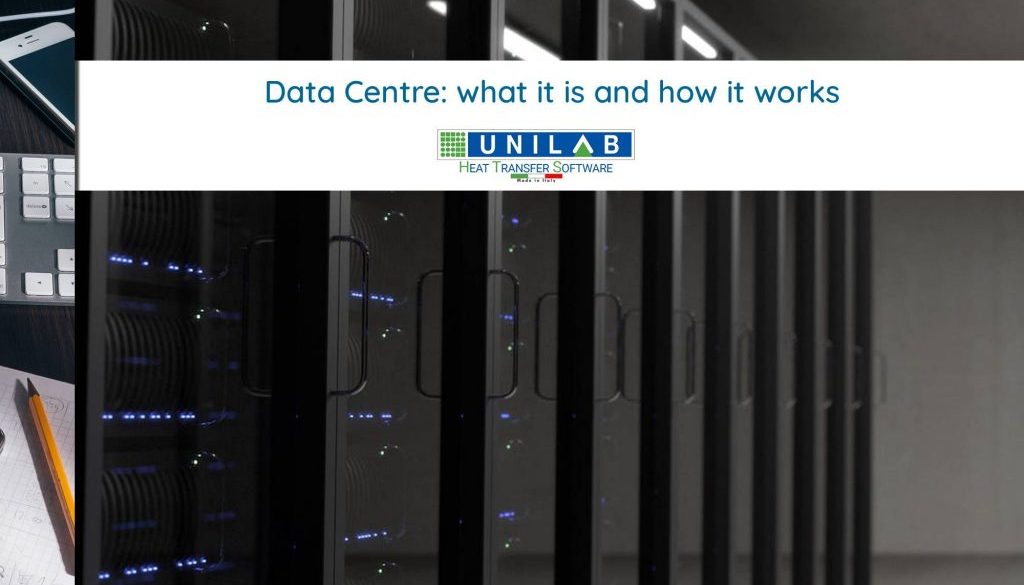
A data centre (or CED – Data Processing Centre in Italian) is a sort of engine room which, as well as servers, houses uninterruptible power supplies and storage and various equipment for the management of processes, communication and services relating to company procedures. In simple terms, this hub guarantees the constant functioning of every IT system and provides a monitoring method as regards the digitalisation of procedures, data processing and computing network definition.
Advances in IT which have, over time, led to components installed inside the CED becoming more powerful, have made it possible for it to process a large quantity of data and procedures. In fact, data centres have had to be fitted with servers of different capacities and varying configurations to permit them to carry out all the required tasks. For this reason, their size varies according to the company’s needs and they may occupy a space the size of a wardrobe (as in the case of a rack server), or several square metres, while some occupy an entire building.
The working of data centres is based on the presence of fixed connectivity systems, which, thanks to a duplicated configuration, are able to ensure operative continuity in the case of a breakdown. Their infrastructure centres on networks which implement the IP protocol and connect the devices to the apps. In addition, in each CED there are various sets of routers and switches designed specifically to send data in both directions between the servers and the outside world. Constant functioning is guaranteed by uninterruptible power supplies and specific climate control systems.
Data centres can be classified into four different levels:
- TIER I: with operational continuity equal to 99.671%;
- TIER II: with operational continuity equal to 99.741%;
- TIER III with operational continuity equal to 99.982%;
- TIER IV: with operational continuity equal to 99.995%.
In order to make a CED secure both physically and logically, it is essential to maintain the operative continuity of the units it contains. Furthermore, it is also important to protect the apps and data produced by its technical systems and contained inside its storage facilities. To succeed in all this, as well as designing the data centre with a built-in earth (which protects against environmental conditions), it is also necessary to take into account human error and cybercrime.
Power is supplied to CEDs via their extremely costly electrical subsets and components. Electrical distribution is dependent on a transformer, a backup generator, a switch, an electrical distribution circuit, an uninterruptible power supply and a PDU. This supplies the circuits connected to every server room, thanks to cables positioned under a floating floor. All power supply chains are cloned inside the data centres according to the relevant certification (TIER I or TIER IV).
As far as consumption is concerned, it can be calculated that a large CED located on a single site can reach 3000 Kilowatts (if we consider a PMI, the estimated average consumption is approximately 300 Kilowatts). In Italy there would seem to be about 3000 data centres, which consume a total of 1 Gigawatt (or one fiftieth of total national consumption). Most of this power consumption is a result of the cooling systems which allow the temperature of the environment to be maintained at between 20 and 22 degrees C.
This concludes our brief overview of data centres: the technical zones which ensure the smooth running of every IT system.
Translated by Joanne Beckwith