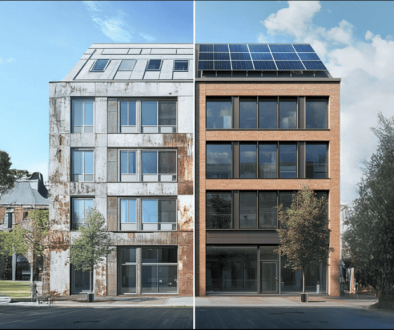
Revised Energy Performance of Buildings Directive: the updates
The European Commission has welcomed the definitive adoption of the Revised Energy Performance of Buildings Directive (EPBD), a crucial stage in the European Green Deal which establishes a framework of reference for member states, aimed at reducing emissions and energy consumption in EU buildings and covers everything related to homes, workplaces, schools, hospitals and other public buildings.
This measure aims to lower the total energy consumption of buildings and improve both the health and quality of life of European citizens. As well as taking into consideration varying national scenarios, it will let member states choose the buildings for energy renovation work and which measures should be adopted. Furthermore, it will stimulate demand for clean technologies produced in Europe, creating job opportunities, new investment and economic growth.
What does the Revised Energy Performance of Buildings Directive entail?
Each member state will devise its own national strategy to reduce the average energy consumption of residential buildings by 16% by 2030 and by 20 – 22% by 2035. At least 16% of non-residential buildings with the poorest energy performance will have to be renovated by 2030 and 26% by 2033.
Some categories of buidings, such as historic buildings or holiday homes, will be eligible for exemptions and citizens will be supported in their efforts to improve their homes via dedicated help desks offering consultation on renovation projects and via public and private funding schemes.
The directive will also boost Europe’s energy independence, in line with the key points of the REPowerEU plan, by reducing the use of imported fossil fuels. With this aim, it establishes that new public buildings must be ‘zero emissions’ from January 1st 2028 while other buildings must meet this requirement by 1st January 2030, with the possibility of certain specific exemptions.
The plan also introduces some guidlines for the progressive elimination of fossil fuels from heating systems in buildings and incentivises the use of solar energy in accordance with the situation in each country. Member states must ensure that the new buildings are ‘solar ready’ and no further subsidies will be granted for autonomous boilers powered by fossil fuels after 1st January 2025.
In the revised document, space is also dedicated to what is known as sustainable mobility, via the pre-cabling of charging stations for electric vehicles and specific areas for electric bicycles.
A crucial revision for energy efficiency
As is already known, buildings are responsible for around 40% of EU energy consumption, over half of gas consumption (mainly used for heating, cooling and hot water provision) and 35% of energy-related greenhouse gas emissions.
Currently, around 35% of buildings in Europe are over 50 years old and almost 75% of buildings are inefficient from an energy point of view, while the average annual rate of energy renewal is a mere 1%.
These are the reasons why in 2020, the Commission presented its Renovation Wave Strategy, aimed at doubling the renovation rate (at least) by 2030, improving energy efficiency and increasing the use of renewable energy in buildings.
The latest revisions to the EPB Directive involve doubling the rate of energy efficiency improvement and tripling renewable energy capacity by 2030, as agreed at COP28. All that remains is to await the publication of the Directive in the official EU Gazette and its subsequent implementation.
Translated by Joanne Beckwith