Smart requalification of buildings: from efficiency to an adaptive system
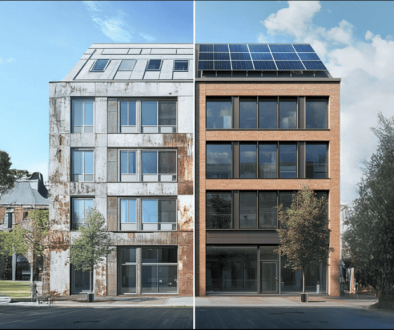
In the last few years, the smart requalification of buildings has taken on a strategic role both in terms of the energy transition and the fight against climate change. It is no longer sufficient to merely improve a building’s thermal performance or install more efficient technological systems; building design criteria need a complete rethink.
Considering that the concept of ‘smart’ requalification implies a systemic approach, in which systems, automation, renewable energy sources and digital management are combined in a coordinated ecosystem. Its dual objectives are firstly to reduce energy consumption and secondly to optimise the entire energy cycle from production to end use, via predictive tools and adaptive control logics.
A new method for meeting energy challenges
The construction industry is undoubtedly one of the sectors with the highest energy consumption and emissions in Europe. Buildings absorb around 40% of the final energy total and are responsible for over a third of CO₂ emmisions. Reducing the impact of this sector is therefore a necessary condition in order to reach the established European Union climate neutrality targets by the year 2050. The challenge involves:
- the need for decarbonisation
- the containment of energy costs, which are increasingly unpredictable due to current geopolitical and market conditions.
In order to respond to both these requirements, a holistic approach is required. A dialogue must be established between the various processes of energy generation, distribution, storage and use. In this particular environment, Building Automation and Control Systems (BACS) and Building Management Systems (BMS) hold the key to sucessful smart requalification.
BACS and BMS: the brain of smart buildings
While BACS involve a combination of control and automation functions at local level and regulate heating, ventilation, illumination, shade panels, security and other similar systems, BMS operate at a higher level. They are tasked with the supervision, monitoring and analysis of data from the subsystems. Both are part of the building’s ‘brain’ and are able to adjust how the building’s shell and systems behave according to actual conditions in real time.
Dialogue between the various components happens via standardised communication protocols which are interoperable and ensure that devices produced by different manufacturers can integrate smoothly. International standards such as UNI N ISO 52120-1 and the ISO 16484 series define the criteria for the planning, installation and management of automation systems, ensuring coherence and quality throughout the building-system’s lifecycle.
The efficiency of the BACS and BMS is measured in terms of energy saving and adaptive capacity. A smart building must be able to learn from historic data, recognise behavioural patterns and adjust its settings autonmously to maintain optimal performance over time.
From the product to the system: the end of the ‘medical’ approach
Although it was long thought that it was sufficient to ‘cure’ a building by installing new boilers, heat pumps or insulation systems, it has now become clear that true efficiency cannot be equated to the sum of several different technologies, rather it is achieved by implementing a coordinated, intelligent system.
A building is not a static entity and its conditions change over time acccording to variables linked to the climate, employment levels, category of use and availability of renewable energy sources. Inflexible procedures like excessive insulation or an over-sized system, can compromise comfort and increase running costs if not calibrated to match the realistic, dynamic use of the spaces.
Smart requalification of buildings therefore requires a switch from an approach based on ‘construction’ logic to a ‘systemic’ approach, in which the designer is not only a technician who proposes solutions, but an authentic ‘doctor’ who analyses and diagnoses issues and defines a personalised energy therapy.
The journey starts with an in-depth energy diagnosis, continues with the definition of intervention scenarios and concludes with the continuous management of performance over time. The aim is to design buildings which are able to adapt to variable conditions, while maximising comfort and minimising waste.
Building therapy: planning based on data and dynamic scenarios
The requalification planning cannot be restricted to a comparison between costs and tax incentives available at the time. Incentives are in reality just transitory schemes, while a building can have a life cycle which may last for decades.
The cost-benefits analysis must take into account the building’s useful life, the potential variation in energy prices and opportunities for integrating renewable energy sources. It is in this scenario that the planner defines the ‘energy therapy’, which consists of a combination of technological and management interventions that are able to adapt to the specific requirements of the context in question.
One practical example is air conditioning: does it make sense to keep heating or cooling systems working when the rooms are unoccupied? A smart system can predict the presence of occupants, pre-heat or pre-cool the rooms according to the programmed times, weather conditions or energy costs. It also uses any excess renewable energy available to store heat, so reducing the use of non renewable energy at peak times.
As well as improving comfort, these predictive logics enable renewable energy to be used more effectively and improve the flexibility of accumulation systems, contributing to the stability of electrical and thermal networks.
Continuous monitoring and evolved maintenance
Once the therapy has been implemented, the challenge is to keep it efficient over time. It must be emphasised that buildings are not static entities; the occupants, uses, weather conditions and technologies can all change. Continuous performance monitoring therefore becomes an essential element in avoiding ‘lapses’ and ensuring that the building remains efficient throughout its lifecycle.
BMS can be used to gather data on energy consumption, comfort, air quality and environmental parameters. This data (analysed using artificial intelligence tools or machine learning) enables any unusual deviations, inefficiencies or upcoming failures to be detected and predictive maintenance strategies to be activated.
This means that the maintenance technician’s role is evolving. It is no longer limited to ensuring the correct functioning of the systems, but is becoming part of a system which ensures that global efficiency is maintained over time.
In light of these developments, it is safe to say that the smart requalification of buildngs provides the route towards transforming them from mere energy consumers to active protagonists of the ecological transition.
Translated by Joanne Beckwith