HYDROCARBONS (HCs) – From domestic to commercial refrigeration: a market in full development
Across the world there are over 600 million hydrocarbons domestic refrigerators – around 36% of the global market for new domestic refrigerators and freezers today, and estimated to rise to up to 75% by 2020 (TEAP2010).
The refrigerant R600a (isobutane) is widely used in fridges and freezers in Europe, Japan, China, which are also available in South America, Canada and Mexico, and are expected to enter the U.S. now that legislative approval has been granted.
Another growing market for hydrocarbons is the portable air conditioning based on propane (R290), which has been on the European market since 1985. In these systems the refrigerant charge is around 0.1 kg/kW.
Australian companies have also been producing a variety of HC-based split-air conditioners for both home and office use. 2011 saw the launch of the first Chinese produced hydrocarbons (R290) room air conditioner, available mainly for export – an important milestone given that 90% of the world’s small air aconditioners are manufactured here. All models meet high European safety standards. They conform to the international safety standard IEC 60335-2-40 and are certified by the German Association for Electrical, Electronic & Information Technologies (VDE), one of European largest technical and scientific associations. Moreover, the final products have been certified by global leader in independent testing TUV.
What is noterworthy is that in China 18 of the 32 air conditioning production lines will be converted to R290 as part of the country’s HCFC Phase-out Management Plan (HPMP). First projects in India are curently under way to build domestic production lines for HC A/C systems. Overall, HC low charge packaged solutions (less than 1 kg) are expected to see increased use, from a market share of below 1% today.
Furthmore, HCs are now used to provide comfort heating and cooling in public buildings within hydrocarbon chillers, which tend to have lower capital costs than ammonia chillers, as they do no need to use “industrial grade” steel components. They have proven safe to install in populated areas, in hospitals and even historical buildings. Prominent installations in the UK include a 600 kW air-cooled water Chiller using R290 (propane) installed in the historic Church House Westminster Abbey in London, UK, while the UK Department of Transport have installed 3 hydrocarbon rooftop chileers on Great Minster House, central London. Arhus University Hospital Skejby, Denmark has installed R600a (isobutane) heat pumps and R290 (propane) chillers for comfort heating and cooling and hot water. In addition to their use in chillers hydrocarbons can be used in ground source heat pumps (GSHP), as is the case in Buntingsdale Infant School in the UK, where heat is extracted from the ground and upgraded to a useful temperature by an R920 (propane) heat pump unit.
Moreover, what is sometimes forgotten is that hydrocarbons are the base molecules for the production of synthetic refrigerants, which are obtained from those by substituting the hydrogen atoms with halogen ones. See figure below for the base hydrocarbon molecules.
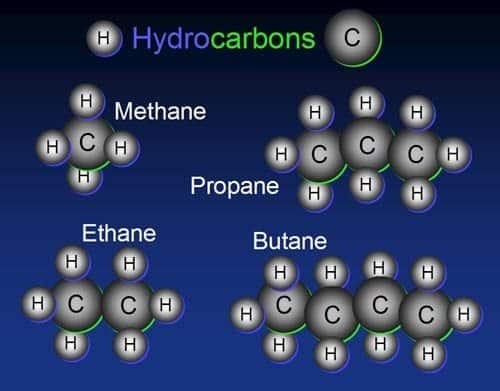
Hydrocarbons molecules
As highlighted in the introduction the commercially available hydrocarbons are: R290 (Propane), R600a (Isobutane), R1270 (Propylene), R170 (Ethane) and R290/R600a mixtures. These hydrocarbons are interesting with no ozone-depleting characteristics and very low – almost negligibile – global warming impact; as well as other natural refrigerants like: carbon dioxide and ammonia, the group of hydrocarbons do not form any by-products or decomposition productrs in the atmosphere. HC refrigerants can be used either in systems designed specifically for their use, or as a replacement in a system designed for a fluorcarbon refrigerant, making them a cost-competitive solution including in developing countries. Of course, hydrocarbon refrigerants are flammacle, and as a result carry an A3 safety classification, which means they a low toxicity, but are in the higher range of flammability. Almost all the synthetic halogenated refrigerants are non-toxic and non-flammable fluids, classifies as A1. For these reasons, HCs are often subjected to stricter safety requirements as regards the quantities allowed in occupied spaces. The next table shows the most important characteristics of the four cited hydrocarbons refrigerant mentioned above.
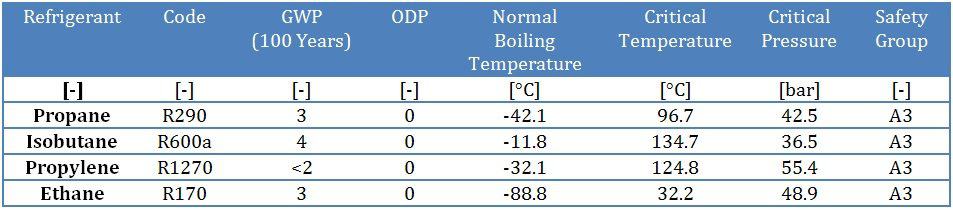
The next figure shows two p-h diagrmas: one for propane (R290, left) and one for isobutane (R600a, right); at a glance, it clearly appears that the saturation curve for R600a is much more inclined than R290. This feature makes R600a suitable for domestic usage because the commonly implemented hermetic compressors take advantages of the low end compression temperature of the gas, which is always very close to the saturation one. Moreover, R600a shows interesting cooling capabilities making it one of the best choices in the case of hermetic compressors, where the thermal management of the electric motor is
accomplished by the cold gas before reaching the compression chamber.


R290 and R600a p-h diagrams
In refrigerating equipment, the two phase heat transfer capabilities of a refrigerant are the most important ones; those are linked to three main thermo-physical properties: liquid and vapour thermal conductivity, specific heat at constant pressure, and dynamic viscosity.
In the case of HCs, these properties make them good refrigerants; in particular, in the range of temperature between -50°C and 50°C, keeping R22 as reference refrigerant, R290 and R600a present higher values of both liquid and vapour thermal conductivity and liquid specific heat at constant pressure. Moreover, in the same range of temperature, These HCs show lower values of both liquid and vapour dynamic viscosity.
At the outlet of all the dry expansion evaporators, the gas must be superheated to avoid the presence and the possible formation of liquid in the suction line. The superheating process can either improve or worsen the system performance; this behaviour depends from the thermo-physical properties of the refrigerant; in
fact, as the superheating increases, both the cooling effect and the compression work increase; this means only if the cooling effect improvement is greater that the additional power needed to compress the gas, The superheating can be considered favourable. The superheating process can be also done using a liquidvapour heat exchanger (internal heat exchanger) where the liquid at the exit of the condenser is subcooled the cold gas at the exit of the evaporator. The refrigerating cycles operating with HCs can be optimized using an internal heat exchanger; in fact, the performance of the cycle increases as both the subcooling
and superheating levels increase.
In general, hydrocarbon refrigerants are fully compatible with nearly all lubricants commonly used in refrigeration and air conditioning systems. One major exception to this rule is lubricants containing silicone and silicate (additives which are commonly used as anti-foaming agents).
Finally, considering the world wide market, over the last 3 years, the Asia-Pacific region has driven growth in sales of hydrocarbon refrigerants. In the Americas, HC sales are dominated by domestic appliances in South America but are expected to pick up also in North America now that the US EPA has approved their use. Global revenues increased by 35% and volumes by 100% in the period 2008-2010, a market in full development.
References
- SHECCO, Guide 2012: Natural Refrigerantis Market Growth for Europe, 2012, Shecco Publications
Correlated topics:
- Carbon dioxide as refrigerant (Technical news no.1 October 2012)
- AMMONIA NH3: natural and efficient, but toxic
- New frontiers of synthetic refrigerants: fluids with limited environmental impact