New frontiers of synthetic refrigerants: low-GWP fluids
Without wishing to evoke what catastrophically prophesied by Mayan about the End of the World, certainly, it is under everyone’s eyes that the Earth is endangered by the Human activities.
The current threat is represented by the global warming, commonly called greenhouse effect; in fact, the scientific community is alarmed about the negative effects that this phenomenon will present in next future, if it is not effectively tackled.
Over the years, the refrigerating and air conditioning industry has faced several challenges: the first was the negative effects that the first refrigerants had on the stratospheric ozone layer. Since 1930, halogenated synthetic refrigerants (i.e. those containing at least one atoms of fluorine, chlorine, bromine, or iodine), also called with their commercial name “Freon”, substituted natural refrigerants, like ammonia, carbon dioxide, etc.
From the refrigeration point of view, the Chloro-Fluoro-Carbons (CFCs), among those we can recall R11, R12 and R113, were outstanding refrigerants, being: safe, efficient, non-flammable, compatible with metals and plastics, chemically stable and cheap.
Unfortunately, after a few decades from their first use, they have been found to have serious effects on the environment. Scientific data supports the hypothesis that the chlorine which those refrigerants are composed has depleted the earth’s ozone layer and is linked to a rise in skin-related diseases. Figure 1 shows the increasing dimensions of the ozone hole from 1980 to 2004. The ozone hole area is characterized by blue-violet-red colours, and its surface constantly increased from 1980 to the late ‘90s, then it became almost constant being around 25 million squared kilometers. The global air conditioning and refrigeration industry have made significant efforts to protect the environment by introducing nonchlorine refrigerants.

Figure 1: Ozone hole from 1980 to 2004. Data by: CSIRO Atmospheric Research, Data NASA GSFC Code 916.
The Montreal Protocol, established in 1987 and later revised, provides guidelines for individual country legislation, setting timetables for the phase-out of chlorine-made refrigerants. Today, more then 195 nations have agreed to the Montreal Protocol.
If the refrigeration and air conditioning industry wants to improve, it is necessary to introduce new refrigerants; as a matter of facts, after CFCs refrigerants, HCFCs (Hydro-Chloro-Fluoro-Carbons) refrigerants became available, and then the HFC (Hydro-Fluoro-Carbons) have been introduced.
Among the HCFCs, R22 is the most important and widely used refrigerant; this synthetic fluid still contains Chlorine atoms, but it shows a very low Ozone Depletion Potential (ODP, ODP=1 for R11), around 0.05.
The European Union declared the complete ban of R-22 in 2015. Meanwhile, since 2004 new air conditioning equipments cannot use R22 anymore, then from 2010 up to 2015, it will not be possible to use virgin refrigerant for maintenance operations. It will be possible to use only reclaimed and recycled refrigerant.
HFCs like R134a, R32, and R410A, which do not destroy the Ozone layer, have substituted the HCFCs and they are now currently used as working fluids in the refrigerating and air conditioning equipments.
As usually happens, every time that a challenge is solved or faced, a new one, even more difficult, rises up.
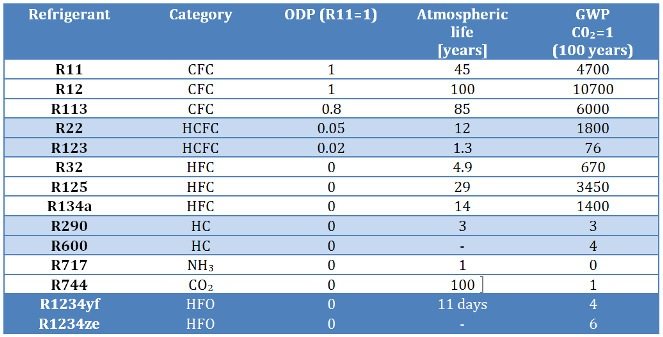
According to the National Academy of Scientists, the temperature of the earth’s surface has risen by about 0.5 K ca in the past century. Evidence suggests that much of the warmth increasing during the last 50 years is caused by greenhouse gases, many of which are the by-product of human activities. Greenhouse gases include water vapor, carbon dioxide, methane and nitrous oxide, and some refrigerants. When these gases build up in the atmosphere, they trap heat. The natural greenhouse effect is needed for life on earth, but scientists believe that too much greenhouse effect will lead to a significant climate change.
The table above lists the bad properties of some synthetic refrigerants from the global warming point of view, as compared to natural fluids. The parameter that quantifies the contribution of each fluid to the global warming is called GWP; this index compares the climate impact of a greenhouse gas emission with the release of the same amount of carbon dioxide, over a fixed time commonly kept equal to 100 years.
For instance, the R12 GWP is equal to 10700, this means that, during 100 years, the greenhouse effect of 1 kg of R12 emission is equal to an emission of 10700 kg of CO2 (CO2 is the reference fluid having GWP=1).
From the analysis of the data reported in the table, it appears that CFCs show the highest GWP values.
Following the historical evolution of the refrigerants, it can be noted that passing from CFCs to HCFCs, and then to HFCs, only the ozone depletion effects have been reduced. The actual refrigerants present high GWP values, i.e. they are formidable greenhouse gases.
The Kyoto Protocol, established in 1997 and later revised, is a legally binding agreement under which industrialized countries will reduce their collective emissions of greenhouse gases by 5.2% compared to the year 1990 (but note that, compared to the emissions levels that would be expected by 2010 without the Protocol, this target represents a 29% cut). The goal is to lower overall emissions from six greenhouse gases – carbon dioxide, methane, nitrous oxide, sulfur hexafluoride, HFCs, and PFCs – calculated as an average over the five-year period of 2008-12. National targets range from 8% reductions for the European Union and some others to 7% for the US, 6% for Japan, 0% for Russia, and permitted increases of 8% for Australia and 10% for Iceland.
In 2006, after a long process through the European Parliament, the F-Gas regulations and the MAC directive became laws. They are focused on the limitation of the use of fluorinate fluids (HFCs, PFCs and sulfur hexafluoride) and on the containment of the refrigerant charge inside the equipment.
The F-gas regulation requires leak inspections, leak-detection systems, recovery, and training and certification. Manufacturers must comply with the requirements on labelling and leak checks.
The most important action for the development of new refrigerants is represented by the MAC directive, which regulates the use of HFCs in the air-conditioning systems in motor vehicles.
In particular, since 1 January 2011, the use of a refrigerant with GWP greater than 150 is banned for air conditioning systems for new vehicle models; in other words, the use of R134a is banned. By 1 January 2017, HFC-134a will be banned for all new vehicles.
Recently, on the wave of these changes, new refrigerants, Hydro-Fluoro-Olefin (HFO) have been suggested as possible substitution of HFCs. As reported in the table, these fluids show very low GWP values, which are comparable with those of natural refrigerants and also they present a negligible atmospheric life. In particular, R1234yf has been proposed as an alternative for R134a in automotive air conditioning systems.
The thermophysical properties of R1234yf are closed to those of R134a, making possible to obtain similar performance with little system modifications. The most important drawback of R1234yf is represented by its, even though small, flammability, which at first has raised some objections about its possible use in vehicles. The R1234yf is classified “low flammable” L2; however, many independent tests have proved is safety during the operations.
From some Life Cycle Climate Performance (LCCP) simulations, the R1234yf results in reductions of 17-20% compared to R134a. Moreover, recently several different mixtures of HFO with R134a and R32, as possible substitutes of HFC refrigerants in civil and industrial refrigerating and air conditioning systems are under development.
After this brief discussion, it clearly appears that the legislation push is the strongest action to force the study, development and production of new technological solutions for environmental preservation and for improvement of the energy efficiency of the equipment.