Tower Suite expands: new Crossflow and Counterflow module with Fill/Packing debut at Chillventa 2026
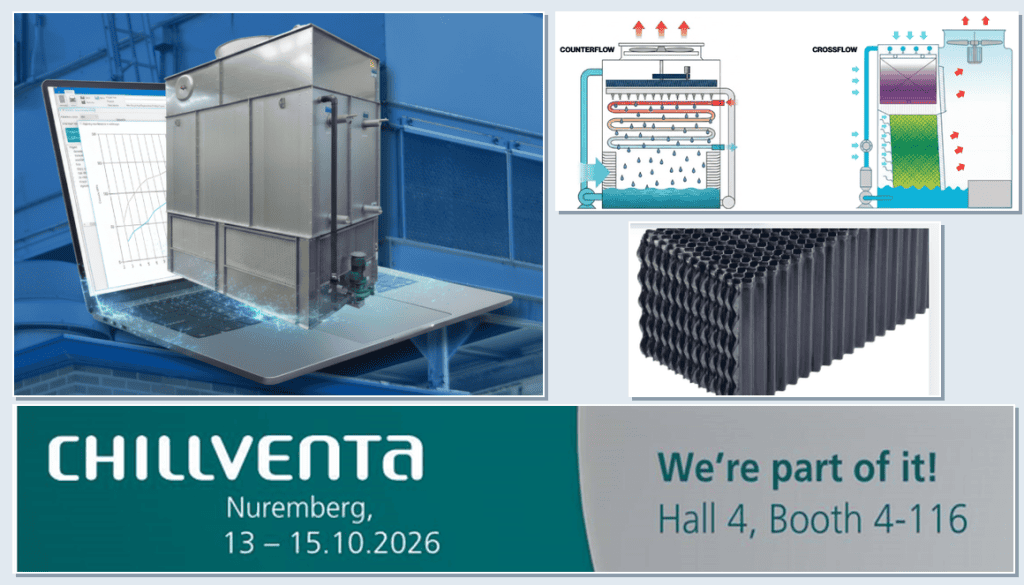
Designing and rating close circuit cooling towers means balancing heat exchange, water management and equipment footprint — all at once. Doing it with fragmented tools, a spreadsheet for one component and a different program for another, multiplies the risk of error and slows down the path from inquiry to technical proposal. That is the problem Tower Suite, Unilab’s software for rating closed circuit cooling towers, was built to solve — and it keeps solving it with two new extensions being presented at Chillventa 2026, running October 13-15 in Nuremberg. Visit Unilab at Hall 4, booth 4-116.
What’s new: Crossflow & Counterflow with Fill
The headline addition coming to Chillventa is a module dedicated entirely to the rating of evaporative cooling towers with fill, covering both the Crossflow and the Counterflow configuration. Fill, coil, spray system and airflow are all handled within a single calculation environment, removing the need for separate tools for each component.
In the Counterflow configuration, warm water is distributed through spray nozzles at the top of the tower and flows downward through the fill, collecting in the cold water basin before being recirculated to the spray distribution system. Air enters through the lower inlet section and rises through the fill and coil in the opposite direction to the water flow, before being discharged at the top — a counter-current geometry that maximizes heat exchange between the two streams
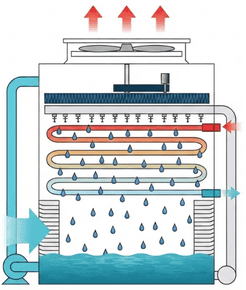
Counterflow configuration
In the Crossflow configuration, water follows the same vertical path to the basin, while air enters through the side inlet louvers and travels horizontally across the fill and coil. Air and water interact across the fill while keeping separate flow paths — a configuration often preferred when air-side pressure drop needs to stay low or when the footprint is a design constraint.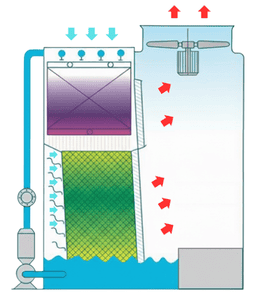
Crossflow configuration
Flexible fill modelling. The software offers two ways to model fill performance: a Merkel-based approach, using empirical equations and performance coefficients, or direct input of manufacturer-specific operating points and performance data. This lets manufacturers model both the standard fill packs commonly used in the market and their own proprietary filling materials, with the same level of accuracy.
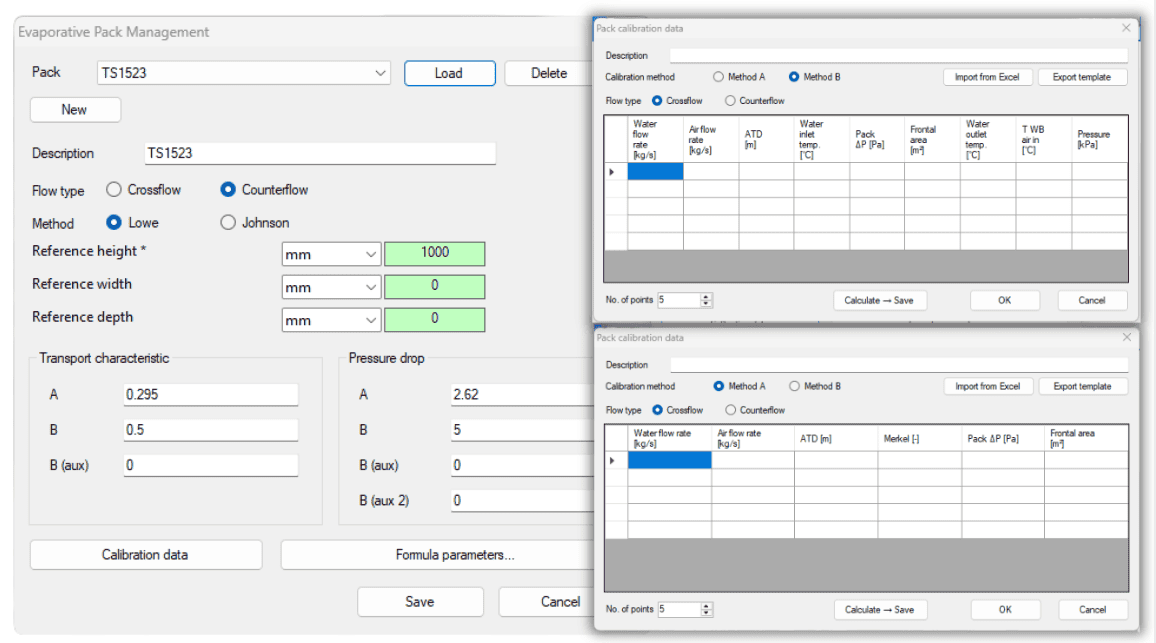
Flexible fill modelling
Tower Suite: one integrated suite for closed circuit cooling towers, unique in the market
Tower Suite was built for manufacturers of evaporative condensers and cooling towers who need a genuinely integrated design approach. The package brings together three modules, which can also be purchased separately — Evaporative Condenser, Evaporative Cooling and, as of now, Crossflow & Counterflow with Fill/Packing — all sharing the same customizable geometry archive and the same validated Unilab calculation engine. The result is an environment where every module speaks the same language as the others, and project data is never lost moving from one tool to the next. A truly unique solution in the market for closed circuit towers.
The foundation of the suite: Evaporative Condenser
The Evaporative Condenser module rates smooth-tube or finned-pack heat exchangers (spiroidal or integral fins) where refrigerant condenses inside the tubes as air flows across the coil. Calculations run in both dry and wet mode, switchable without redefining the unit. An expandable geometry archive, already populated with the configurations most used in the market, can be enriched with the manufacturer’s own data and fine-tuned against test results.
One detail that often matters most at the design stage: the software calculates the exact quantity of evaporated and sprayed water — a figure that directly drives make-up water costs, blowdown volumes, and the water-treatment strategy needed to control scaling and Legionella risk. For units that produce visible water-vapor plumes, with the associated risk of ground icing, a plume abatement coil can also be modelled — the finned-pack heat exchanger placed ahead of the spray system that pre-cools the refrigerant before it condenses.
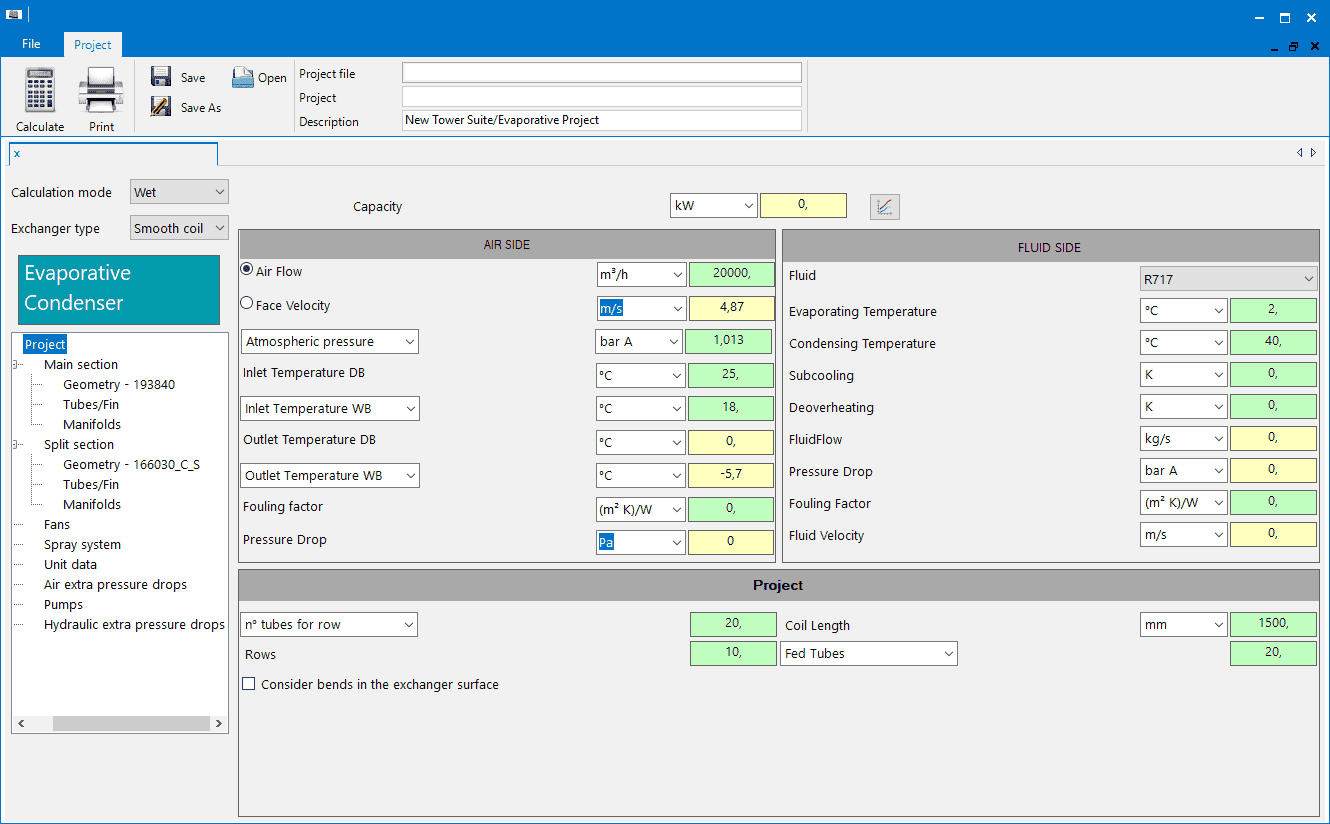
Evaporative Condenser
The foundation of the suite: Evaporative Cooling
The Evaporative Cooling module calculates adiabatic cooling — with no change of phase — of a pure liquid or a liquid mixture flowing through the tubes. As with the Evaporative Condenser module, calculations run in both dry and wet mode, sharing the same geometry archive and the same rigor around evaporated and sprayed water volumes. Fluids and mixtures can be selected from the REFPROP database or built as custom blends, with properties automatically recalculated as composition changes.
A dedicated chart overlays the thermal balance from the design duty (in blue) against the capacity delivered by the actual coil geometry (in orange): the crossing point between the two curves gives the resulting capacity and fluid flow rate, offering an immediate visual check on how the as-built unit compares to the original design.
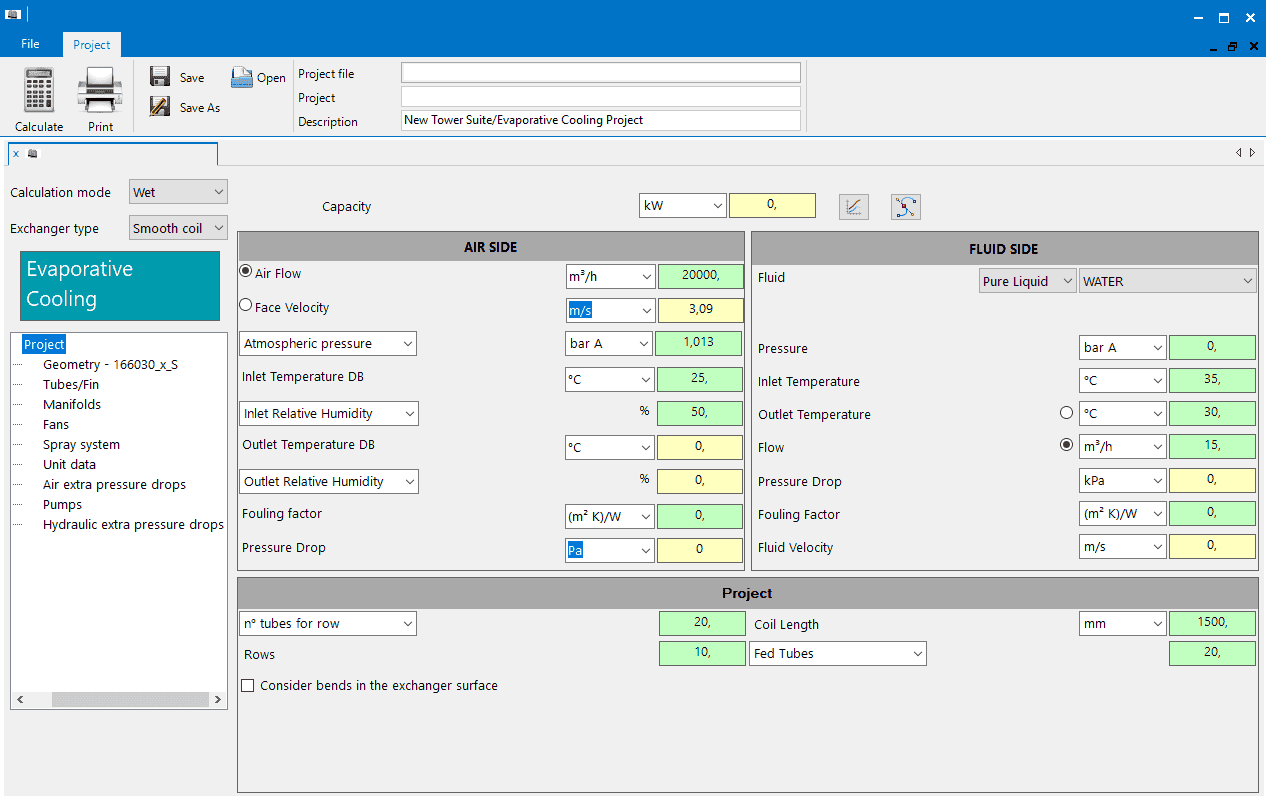
Evaporative Cooling
Why one integrated suite matters
The value of Tower Suite isn’t only in the individual modules, but in the fact that they share the same geometry archive, the same fluid database and the same validated calculation engine. Data entered once — a geometry, a fluid, a material — is available across every module, and it’s exactly this integration that cuts down transcription errors and shortens the time between an inquiry and the final technical proposal.
Meet us at Chillventa 2026
The Unilab team will demo the new Crossflow & Counterflow with Fill capabilities live at Chillventa, October 13-15 2026, in Nuremberg Hall 4, Booth 4-116. If you design or manufacture evaporative condensers and cooling towers, this is the place to see Tower Suite in action and talk through your specific equipment needs with our engineers.
Chillventa 2026 | October 13–15 | Nuremberg, Germany | Hall 4, Booth 4-116
Want to book a meeting at the booth or request a demo? Get in touch to arrange a time during the show (sales@unilab.eu).