The zero water use data centre: a possibility?
The rapid spread of artificial intelligence is radically transforming the data centre sector. The increase in calculaton capacity required to power AI models (from training neural networks to real time inference applications) is resulting in constant growth in rack density and in the quantity of heat generated by the servers. While, in the past, the focus was mainly on energy efficiency, a different variable, destined to become just as critical, must now be considered: the management of water resources.
It is in this context that the concept of zero water use is gradually gaining significance. Thanks to advances in cooling technologies, it is now possible to design infrastructures capable of maintaining high thermal performance levels without the need to use water evaporation during the heat dissipation process. This solution brings together key factors such as sustainability, operational reliability and digital service continuity.
From PUE to WUE: how to measure a data centre’s sustainability
For over ten years, the main parameter used to measure data centre efficiency has been Power Usage Effectiveness (PUE): an indicator that measures the total energy consumed by the data centre in relation to the energy actually used by the IT hardware. A value approaching ‘1’ corresponds to a high level of energy efficiency and is therefore the target many international operators aim for.
However, an increased PUE has often been achieved through the use of evaporation cooling systems. Although they are particularly efficient from an energy point of view, these systems require the continuous use of water to disperse the heat produced by the servers. With the expansion of AI based workloads, the limitations of this type of solution are becoming increasingly evident, especially in locations where water resources are already in short supply.
As a result, a different indicator has been established: Water Usage Effectiveness (WUE), which measures the quantity of water used per kilowatt-hour of energy consumed by the data centre. Traditional infrastructures typically achieve a figure of around 1.8 litres per kWh on average, while more advanced systems are able to reduce consumption to around 0.2 litres. Thanks to the latest generation of thermal architectures, it is now possible to achieve zero water consumption.
The validity of the WUE has also been recognised in international standards such as ISO/IEC 30134 and EN 50600, which consider it a complementary parameter to the PUE in the overall assessment of a digital infrastructure’s environmental performance. The goal is not only to lower energy consumption but also to preserve precious water resources, which are increasingly exposed to the effects of climate change.
The new technologies which enable zero water use
Advances in cooling systems have opened up scenarios which up until a few years ago were unimaginable. New thermal architectures allow water use to be totally eliminated, without compromising the performance levels required by modern AI-based workloads.
The principle forming the basis of these solutions involves abandoning evaporative cooling in favour of air based systems or configurations using refrigerators integrated with dry coolers, therefore completely eliminating evaporation as a method of heat dissipation. In this way, the cooling cycle becomes totally independent from the issue of water availability at the site.
When climate conditions mean that a different configuration is more suitable, a dual phase centrifugal refrigerator system integrated with dry coolers can be used, maintaining the heat dissipation process without the need for water consumption. The determining factor is therefore not the presence of a specific technology, but the ability to choose the most suitable solution according to:
- climate;
- geographical location;
- and operational requirements.
The entire architecture is also supported by validated design guidelines, which help designers and managers create infrastructures scalable to gigawatt level, maintaining high efficiency standards with zero water use.
The choice of cooling system depends on the local area
Considering that each individual data centre is built in a specific climate context, one universal solution to suit them all cannot exist. Water availability, external temperatures, humidity levels and seasonality all directly and inevitably influence the design of cooling systems.
In desert or drought hit regions, such as the Middle East or the Southwest United States, eliminating water consumption can become an essential prerequisite for the authorisation of new investment. In contrast, in northern European regions, where the climate is cooler and rainfall is plentiful, different strategies may be adopted, which exploit local environmental conditions more effectively.
The growing spread of data centres destined to support artificial intelligence makes this capacity to adapt even more essential. New generation racks develop far greater thermal outputs compared to the past and require increasingly sophisticated systems to ensure operational continuity, safety and reliability.
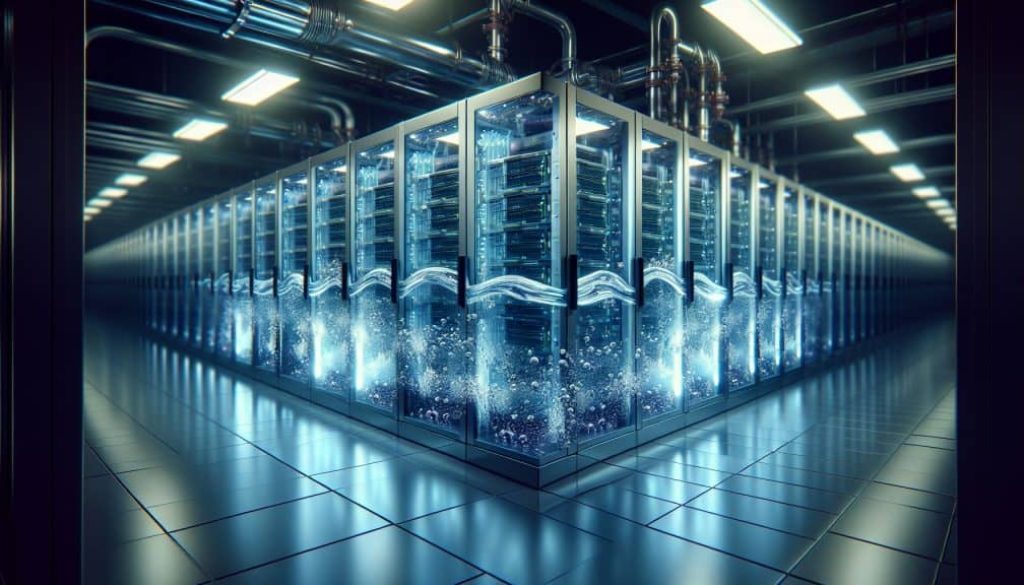
Modern design takes into account the entire cooling chain, including liquid distribution units, fan coils, high efficiency chillers and smart control systems, which constantly monitor temperature, capacity and performance. An integrated management approach allows for the optimisation of each component, the reduction of waste and the improvement of infrastructure resilience, even in the presence of variable loads.
The future of data centres starts with energy efficiency and water sustainability
The expansion of artificial intelligence will continue to increase demand for calculation capacity in the coming years. At the same time, growing responsibility will be placed on operators to design infrastructures compatible with environmental sustainability objectives. In this scenario, zero water use represents one of the most significant innovations capable of combining technological development with the protection of natural resources.
Reducing their water consumption makes the construction of new data centres possible, even in areas where water availability is considered a limiting factor. At the same time, it also means reducing pressure on aqueducts, improving infrastructure resilience in periods of drought and encouraging more responsible management of the entire production cycle.
Research continues to develop new solutions to further increase the efficiency of cooling systems, integrating smart sensors, predictive algorithms and AI based management platforms. The aim is to monitor operational parameters in real time and automatically adapt the system operation according to both the environmental conditions and variations in workloads.