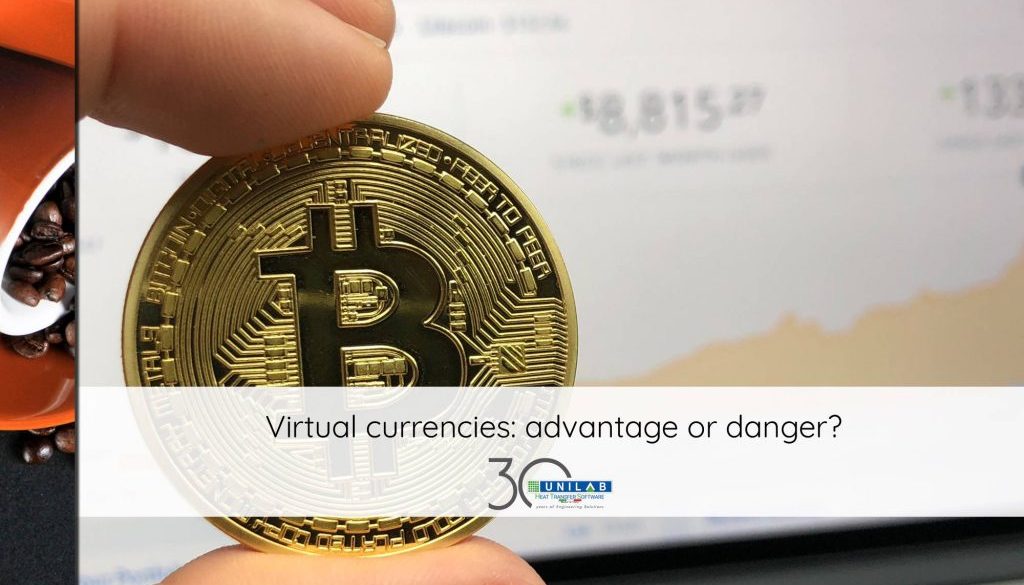
Virtual currencies: advantage or danger?
When referring to virtual currencies, there is a tendency to consider almost exclusively the infamous bitcoin. This is a common approach which derives mainly from the fact that the bitcoin is certainly the most well-known virtual currency of all. However, it is certainly not the only one and over time such currencies have increased significantly in number, making their presence felt on the current financial scene.
Despite this subject being a frequent one for discussion lately, it is actually quite complicated to establish how many and which virtual currencies are effectively valid. The website coinmarketcap.com has tried to do this and there are 78 currencies featured on the site. Below we will give a brief overview of the main ones.
Bitcoins
As mentioned above, this is the currency whose origins and history are the most familiar. Created in 2009 to eliminate the need for intermediaries such as banks during the phases of money creation and economic/financial transactions. Today, bitcoin transactions are carried out through mining, which refers to the simple resolution of an algorithm: once the problem is resolved, a block of bitcoins is processed.
Dogecoin
This currency appeared in 2013 and its main operational features were inspired by the bitcoin. As far as quality is concerned, the dogecoin has a ‘meme’ image: a dog of Japanese breed accompanied by some phrases in English, with some grammatical errors.
Litecoin
This currency came to public attention in 2011; its real value has increased considerably recently, with a leap from 0.05 dollars to 48 dollars (during that recent period it subsequently re-stabilised at 23.48 dollars). Compared to bitcoins, the litecoin differs in the confirmation of transactions (faster) and in the mining process (which can be done using more commonly found programs).
Peercoin
This currency was created in 2012 and makes use of the proof-of-stake method, which obliges those who carry out transactions to identify themselves. In contrast with the first currency we described, this one refutes mining in so far as it is contrary to its ecological and democratic ideals. It is also worthy of note that the algorithms on which it is based are gradually becoming simpler.
Namecoin
Debuting in 2011, it settled at a value of around 5.82 dollars following the crisis of 2013. This currency has an internet domain which cannot be checked through Icann and therefore the operations cannot fall victim to espionage activity. The maximum quantity of namecoins that can circulate is 21 million.
Quark
In contrary to the situation with bitcoins, quark uses a different security system which greatly increases its levels of protection. Each transaction can be carried out in just 3 minutes and the real value can be checked at any time. Although not yet widespread, this currency created in 2013 is the most secure.
Now that we have provided a brief overview of the main virtual currencies in circulation, let’s find out why they are so popular. According to the chairman of Coindesk Jeremy Bonney, this is due to the fact that their production systems, based on algorithms, increase their level of security. Furthermore, they are used by a large number of people who have the opportunity to check the outcome of transactions in real time (thereby guaranteeing transparency).
Of course there is no shortage of analysts with opposing views, who consider virtual currencies a step towards an increase in crime rates, but, despite this, digital currencies are spreading at an exponential rate.
Translated by Joanne Beckwith