Air-conditioning and domotics: a winning combination
It is becoming more and more common to refer to air-conditioning as a technology which lends itself perfectly to domotics: a system which enables optimal power consumption, while ensuring a cool environment, even during the hottest periods of the year.
Domotics has a wide range of uses and is now used by some hoteliers to turn the air-conditioning off as soon as guests open their windows. It can also be used to partially cover some areas of the building during the hottest hours of the day.
When connected to an air-conditioning system, it allows you to set the system to switch on at the required time, thereby only cooling rooms or other areas when necessary.
If it is connected to other electrical appliances, it allows them to operate at different times, so as to avoid unnecessary power overloads, thereby eliminating the risk that the washing machine, oven, dryer, microwave etc. will cause a power outage.
Smart or automated living (also known as the Internet of Things) is able to manage all the appliances commonly found in a domestic or professional environment, thanks to its use of a single language. This language is able to communicate with appliances, telling them how and when to switch on.
By using a normal smartphone, this technology allows us to set the water-heater, check the alarm system, turn on the lights as soon as we arrive home or lower the external blind if the sun starts to get too hot.
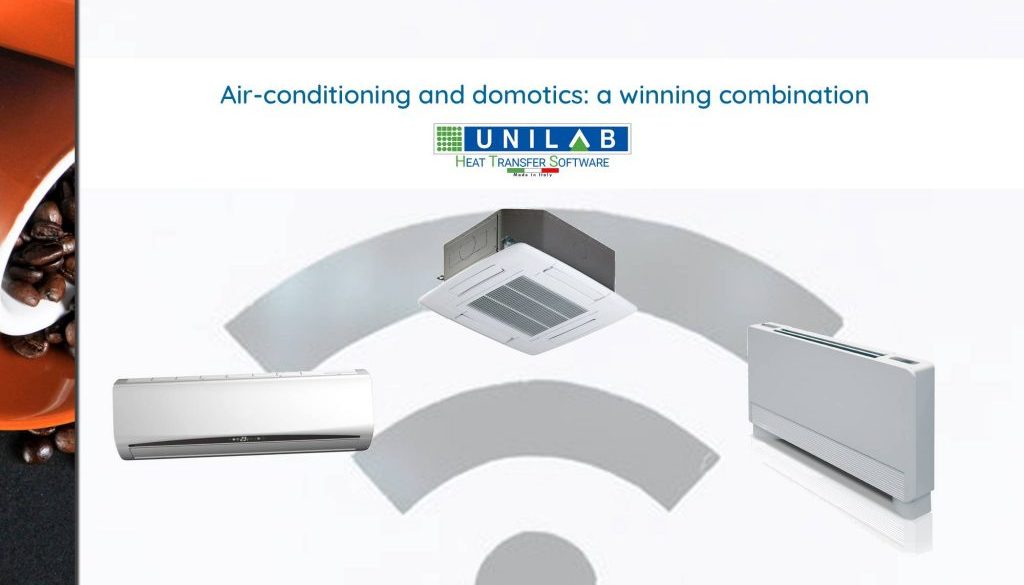
As far as air-conditioning is concerned, the Internet of Things uses a universal remote control which can manage any air-conditioning system via an App: with the installation of a central hub, the whole system can be managed by smartphone.
The installation does not require any electrical cables and the hub contains all the active sensors which detect levels of temperature, light, movement and humidity, which assist in the regulation of the air-conditioning in the surrounding rooms.
As well as controlling the temperature from a distance (for example from the office or in any case from outside the home), the app uses the smartphone’s GPS to turn the air-conditioning on when you arrive home and to turn it off when you are away from your smart home.
The control hub interacts with the air-conditioning system via infra-red signals and connects to the internet via wi-fi, while the app (downloadable from the web) is available cost-free for all major operating systems (Android and iOS).
Considering its many features, smart living is without doubt a revolutionary technology, especially when used in conjunction with air-conditioning systems. It can adjust the temperature inside buildings to make you more comfortable, while reducing wastage and the environmental impact.
Regarding this last point, just think how many air-conditioning systems have been installed in the last few years, especially in Italy, which represents 31% of the total European market.
That is an alarmingly high number which will cause exorbitant power consumption levels and further add to the problems of a Planet already pushed to its limit by the actions of its inhabitants: human beings.
The growing use of domotics among the general population can reduce this kind of problem, by cutting consumption, limiting wastage on electricity and its costs and allowing electronic appliances to function in a smart way.
Up to now the costs of installing the Internet of Things have meant that it has not been available to all. Despite this however, the progress of technology could make the entire domotics market much cheaper in the future.
The next step ought to be to teach people about the nature and number of the many benefits that this great technology can really bring.
Translated by Joanne Beckwith