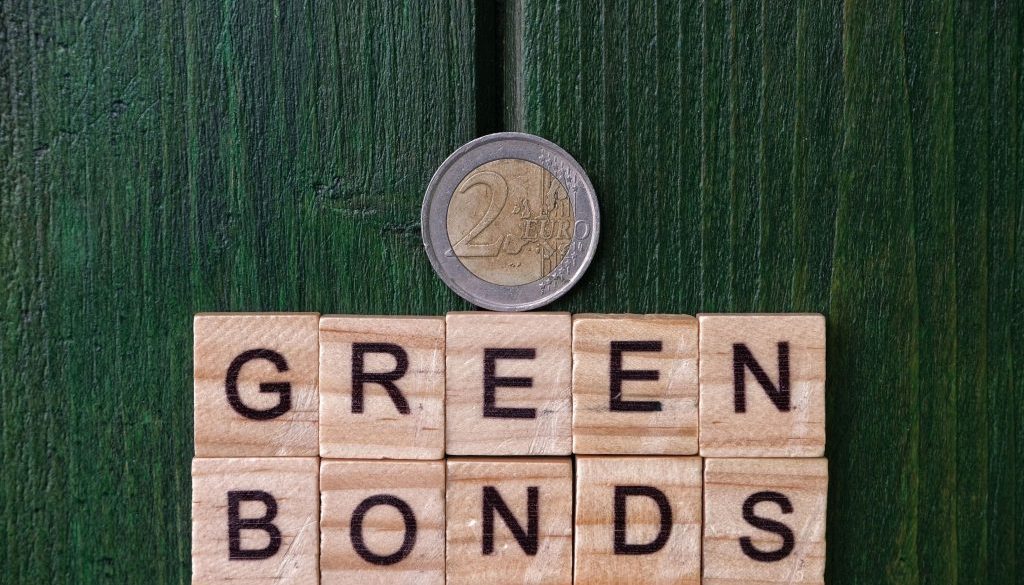
What are Green Bonds?
Green Bonds are bonds associated with the financing of environmental projects. In recent years, growing public interest in the fight against climate change has led to their increasing success on international financial markets.
Interest has risen markedly in the last decade, with a total of 400 billion bonds being issued in 2021. It is estimated that by 2022, their stock value (of all bonds in circulation) will exceed one trillion dollars.
The features of green bonds
In order for a bond to be considered ‘green’, it must possess certain essential requisites. The ICMA (International Capital Markets Association), has drawn up a detailed definition, so that companies issuing these bonds have a clear idea of the principles that must be respected:
- Selection of the project to finance or re-finance;
- Any income must only be invested in the selected project (the money is deposited in a controlled account, transferred into a specific portfolio or otherwise traced by the issuer);
- Once a year, a statement must be provided, outlining how the income from the bonds is used, indicating the projects in which it is invested;
- A second opinion must be provided, allowing for an external audit in order to certify documents and objectives.
This system is a form of market self-regulation, without recourse to legal penalties. Nevertheless, companies issuing bonds who do not follow the principles mentioned above, risk damaging their reputation, leading to serious financial loss.
As mentioned above, in order to be considered ‘green’, the bonds must be used for financing and promoting projects connected with the environment. There is a (non-exhaustive) list which includes examples of suitable projects:
- Renewable sources of electricity and heat;
- Energy efficiency;
- Transport;
- Prevention and control of pollution and the circular economy;
- Safeguarding the environment and biodiversity;
- Research into the environmental sustainability sector.
According to the World Economic Forum (the organisation in charge of the Davos forum, which, in the early months of 2021, issued the above regulations), only bonds falling into one of these categories (or related ones) can call themselves ‘green’.
The history of green bonds around the world
The first green bonds were issued by a small group of American financiers in 2013, when the value of the bonds did not exceed a few tens of millions of dollars. In 2017, the total value of bonds issued had already reached 100 billion and by 2019, it had reached 200 billion dollars.
In 2020, green finance, like other sectors, encountered a difficult period, recording a slight fall in the number of bonds issued, while in 2021, that figure exceeded 400 billion, mainly due to the timid economic recovery seen in various countries.
Thanks to more defined, stricter policies, enforcing a ban on investment in fossil fuels and increased awareness of environmental issues, such as global warming, pollution and climate problems, the value of green bonds is set to rise.
European companies are among the first in the world to have embraced change in that direction, with large energy corporations recently presenting projects designed to guarantee greener production by the year 2050. This has led some states to formulate their own green commitments: among these, the first nation in Europe to issue a green government bond was Poland, in December 2016.
On February 25th last year, Italy also made its own contribution, linking its bonds to initiatives like smart cities, the ecological conversion of old government-owned sites which are still polluted, the creation of photovoltaic or solar power plants and other interesting environmental projects via project financing.
Translated by Joanne Beckwith