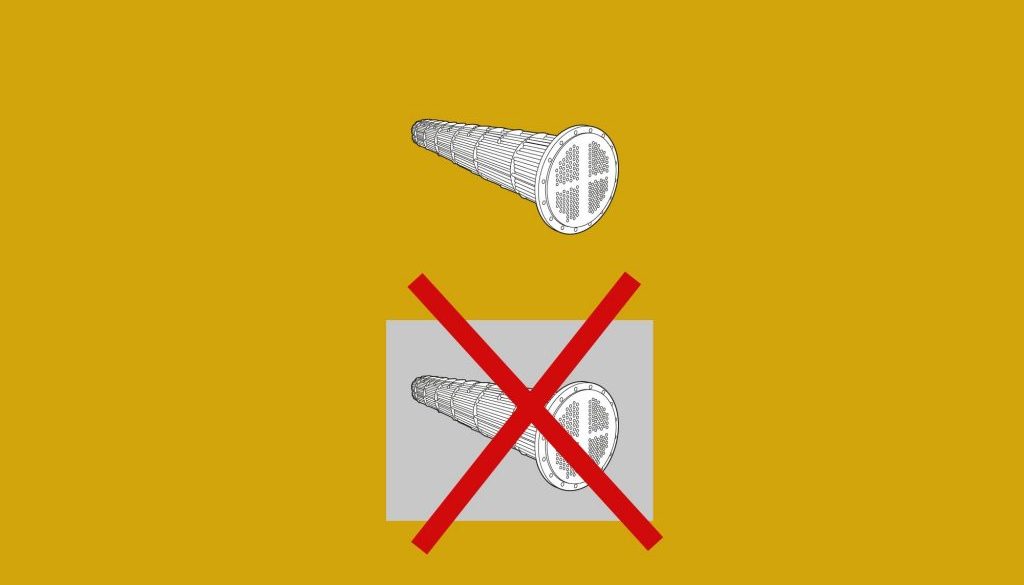
Shell and tube heat exchangers: replacement or repair?
The dilemma of replacement versus repair when shell and tube heat exchangers encounter operational problems is quite common. Such devices are quite delicate and in order to work properly, it is essential that their structure is in perfect condition and there are no defects.
There are numerous possible reasons why shell and tube exchangers deteriorate: design defects, wear and tear, unexpected chemical reactions to name a few. Identification of the problem is therefore a crucial step towards establishing whether it is more cost-effective to repair the damaged components or replace the exchanger completely.
Repair versus replace: six steps to identify the problem
The choice whether to repair or replace the heat exchanger very much depends on the nature of the problem affecting it. As this equipment is generally used in an industrial environment (such as in plastic moulding), it is clear that before proceeding with a complete replacement (which involves stopping production totally and incurring financial losses), all alternatives must be considered.
The decision as to whether replacement or repair would be better, is the task of specialised technicians who, generally, use six steps to identify the problem and evaluate the extent of the damage.
- Performance analysis: the first step consists of analysing the device’s performance. Using special instruments and careful monitoring of specific parameters (like inlet and outlet temperature, fluid flow, vibrations etc.), the nature of the problem can be ascertained relatively easily.
- Contact technical support: it is a good idea to contact the supplier of the device, even if it seems that the problem has already been identified. This allows for more specific suggestions regarding what repair work should be carried out and how (if possible) or for them to provide support on the premises directly.
- Professional testing methods: if the problem is difficult to identify, it is essential to carry out professional tests using specialised equipment. This job is usually entrusted to technical support. One of the most widely used tests (as well as one of the most efficient for identifying the type of problem) is that of eddy currents. This analysis in particular is able to give quite precise data, without the need to dis-assemble the whole exchanger.
- Extract a tube sample: if the problem still can’t be found, a tube can be removed, in order to carry out further analysis. Some tests can even determine the state of wear and tear and how much longer it can continue to operate before breaking down. It is however, quite an invasive procedure, which tends to further delay production.
- Tests and simultaneous repair: a good method to speed things up is to combine repair with testing. The technician who normally deals with diagnosing the problem, often has the skills to resolve it too. If, rather than replacing the exchanger, a decision is taken to repair it, this system is an ideal way to reduce production stoppage to a minimum.
- Refit or replacement: the last choice available to a factory experiencing problems with shell and tube exchangers is replacement versus refit. In the case of a refit, costs and repair times are much too great, so it is much more cost-effective to replace the device. In the latter case, the damage is serious, but it can be reduced with a partial reconstruction of the unit.
In conclusion, the choice between replacement or repair is closely linked to the nature of the problem. Technical support can and must always be involved in order to diagnose the problem and identify the correct procedures, so as to reduce costs and keep financial losses to a minimum.
Translated by Joanne Beckwith